















A pergola is one of the quickest ways to make a Dubai villa garden usable for more of the year. But before anything is ordered, there is a step many owners underestimate: approvals. In most villa communities, a pergola counts as a modification to the property, and it needs the right sign-off before work starts. This guide explains what is usually involved, what to prepare and how to avoid delays.
Why a pergola needs approval at all
Villa communities in Dubai are planned as a whole. Developers and community managers set rules on height, setbacks, colours and materials so that streets keep a consistent look and neighbours are not affected by what is built next door. A pergola changes the outside of the villa, it is fixed to the ground or the façade, and it often brings electrics for motors and lighting. That is why it is treated like other landscaping or extension work, not like garden furniture.
The exact process depends on where the villa is. Some communities only need a no-objection certificate (NOC) from the master developer or community management. Others also involve the relevant authority, for example the municipality or the authority responsible for that area. A clear overview of how this works for landscaping projects is the villa landscaping NOC approval guide from Lushly Pools, which walks through the documents and steps in detail.
What is usually checked
- Position and setbacks: how far the pergola sits from boundary walls, the street and the neighbour's plot.
- Height: many communities limit how high a structure may rise above the boundary wall.
- Colour and material: frames often have to match or suit the villa's existing colour scheme.
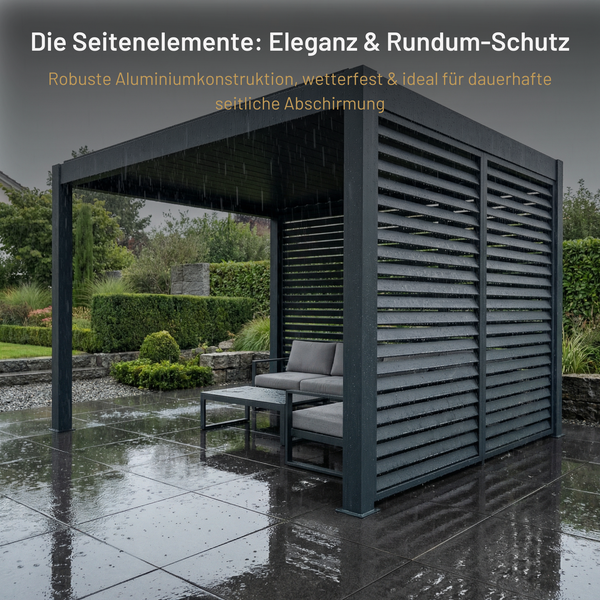
- Roof type: open louvres, fixed roofs and enclosed sides can be assessed differently, because enclosing a space may count as adding built-up area.
- Foundations and fixings: how the posts are anchored and whether anything is fixed to the villa structure.
- Electrics: outdoor power for motors, lighting or heaters, which should be installed by a licensed contractor.
- Drainage: where rainwater from the roof goes, so it does not run onto a neighbour's plot or against the façade.
What to prepare before applying
Most delays come from incomplete submissions. It helps to have these ready before the application goes in:
- A simple site plan showing the villa, the plot boundaries and the pergola's position with dimensions.
- Elevation drawings or a product drawing with the overall height and roof type.
- Material and colour details for the frame.
- Details of the foundation or fixing method.
- The contractor's trade licence and, where required, their insurance documents.
- Owner documents such as the title deed and, for tenants, the landlord's written consent.
Tenants and landlords
If you rent the villa, the landlord's written approval comes first. The community will usually only accept an application from the owner or with the owner's consent. It is also worth agreeing in writing what happens to the pergola at the end of the tenancy.
Timing: plan approvals into the project
Approval times vary by community and by how complete the application is. The best approach is to treat the NOC as part of the project timeline rather than a formality at the end. Agree the design first, submit the full package once, and only schedule installation when the approval is in hand. Starting work without it can lead to fines or a request to remove the structure, which costs far more than the wait.
Combining a pergola with other garden work
If a pool, hardscape or new planting is also planned, it often makes sense to submit everything together. One combined application avoids repeated submissions, and the foundations, drainage and cable routes for the pergola can be planned with the rest of the garden instead of being added later.
Checklist
- Check your community's rules for outdoor structures before choosing a design.
- Confirm whether only a developer NOC is needed or also an authority permit.
- Prepare plans, product details, contractor documents and owner consent in one package.
- Plan drainage and electrics as part of the submission.
- Schedule installation only after approval.
Conclusion
Approvals are rarely the exciting part of a garden project, but they decide whether it runs smoothly. With a clear design, a complete package and realistic timing, a pergola can usually be approved without surprises and then enjoyed for many years.


