
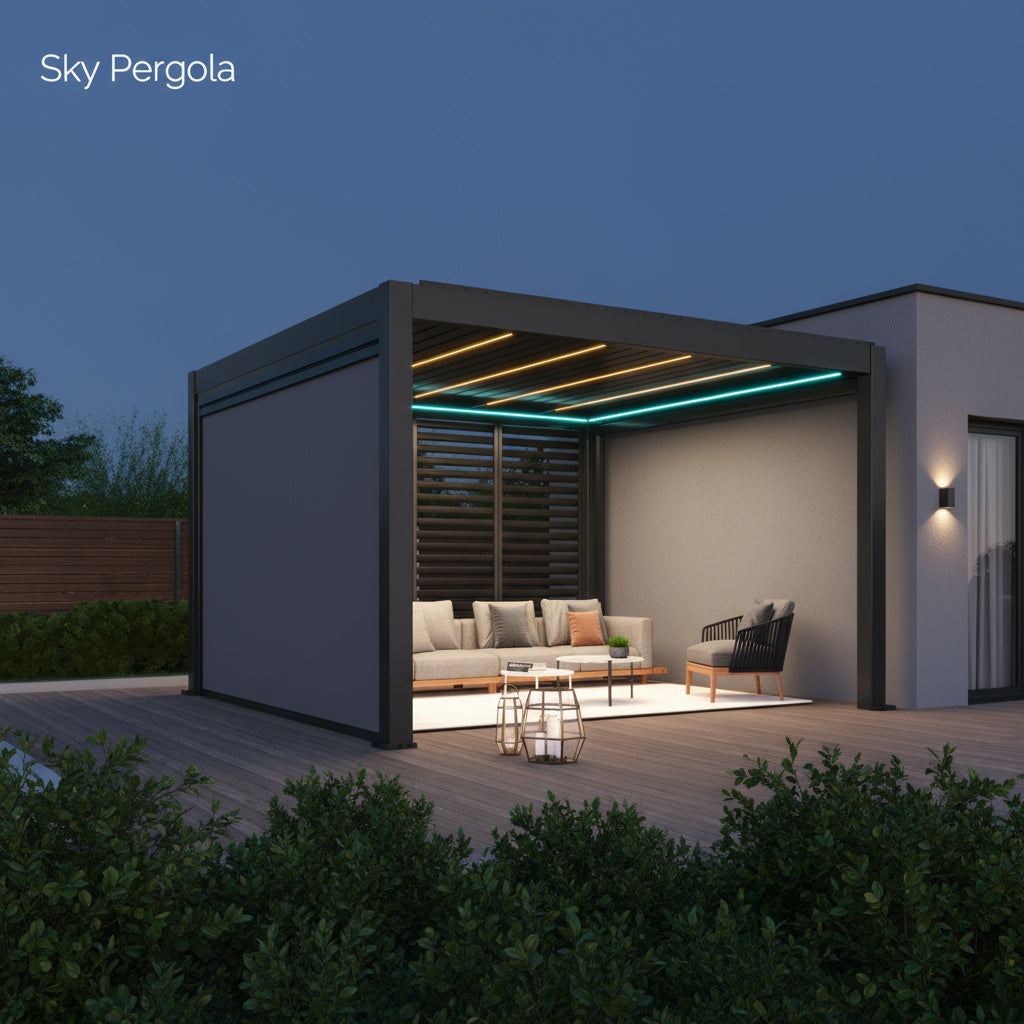
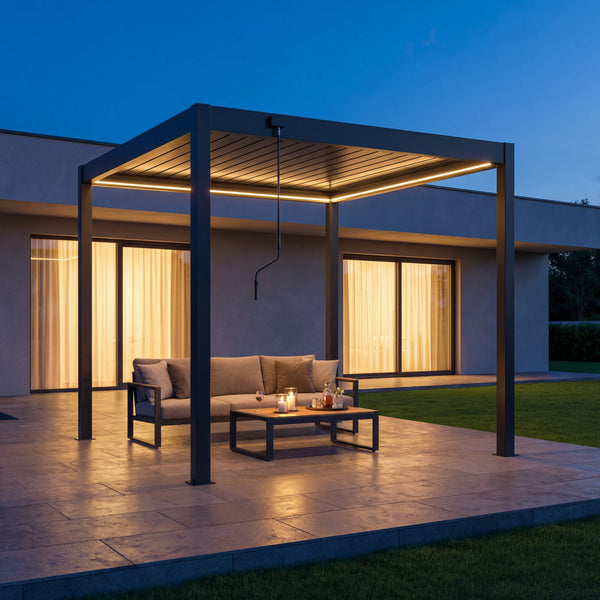
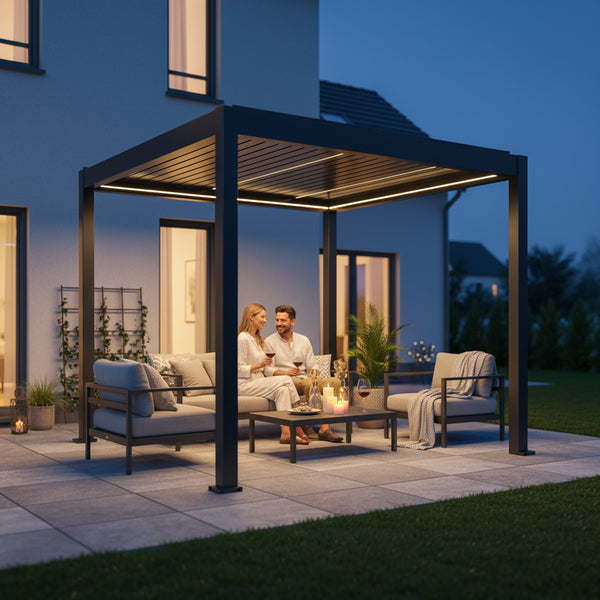
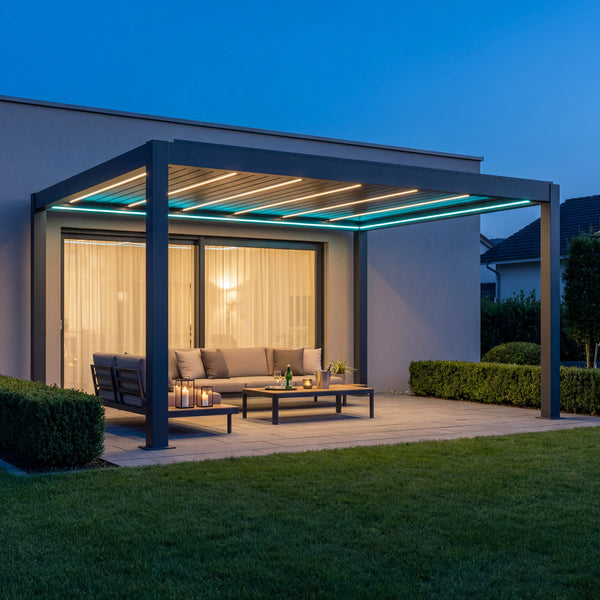




An aluminium pergola gives you plenty of second chances. Colour, side screens, glass walls, lighting, a heater, a fan, even the way you drive the roof can be chosen late in the process. Two things cannot be changed: the axis the louvre blades run in, and the way the whole frame sits relative to the sun. Once the posts are anchored and the beams carry the blades in one direction, that direction is fixed for the life of the structure.
This guide is about those two decisions. It covers how a north-south louvre run behaves differently from an east-west run hour by hour, what the sun actually does on Dubai's latitude across the year, which hours of the day a west, south, east or north terrace really gives you, and when the honest answer is not the roof at all but a vertical element. It closes with a method you can run yourself in a single day, so you arrive at the planning conversation with measurements rather than impressions.
The season matters as well. From late October the midday sun stands far lower than it did in July, and that is precisely when a flat roof begins to let sun in from the side. The pergola that felt perfect in August can feel useless at four in the afternoon in January. That is not a product fault, it is geometry, and you can plan around it if you understand it before you order.
Key takeaways
- Louvre run direction and the rotation of the pergola on your terrace are effectively permanent. Colour, screens, glass, lighting and controls are not, so give the irreversible choices your attention first.
- A north-south louvre run is the better default for UAE terraces, because the blade faces can be turned against the low eastern and western sun that drives almost horizontally under a roof [1], and because north-south orientation performs better for the daytime heat balance in hot arid cities [2].
- On this latitude the noon sun swings from roughly 88 degrees in June to roughly 42 degrees in December [3], a change of about 47 degrees between the solstices [4]. A horizontal roof is strong against the first figure and close to powerless against the second.
- From October to March the answer to low sun is vertical, not horizontal: a side blind, a sliding louvre wall or planting. Shade works by covering sky, and a roof alone leaves the sides open [5].
- Shade mainly lowers radiant temperature, not air temperature; studies of shaded urban geometry and dense tree canopies report reductions of 15 to 30 degrees Celsius in mean radiant temperature [5][6]. The World Health Organization lists clothing, sunscreen and a hat in addition to shade, not instead of it [7].
- Your phone is accurate enough for this job: magnetic declination in Dubai is only about 2 degrees east [8], so a compass app reading needs barely any correction.
The one decision you cannot revise
Fixed on the day the posts go in
Two things are settled when the frame is anchored. The first is where the pergola stands and how it is turned, which decides which part of your floor is in shade at any given hour. The second is the axis the louvre blades run in. Blades sit in the beams in one direction only, and they pivot on that one axis, through roughly 0 to 135 degrees. Turning a finished pergola ninety degrees is not an adjustment, it is a new structure on a new foundation.
Everything downstream of those two choices is a matter of degree. A roof that is well oriented forgives a lot of later mistakes. A roof that runs the wrong way for your terrace has to be compensated for with screens and timing for as long as it stands.
Still open long after installation
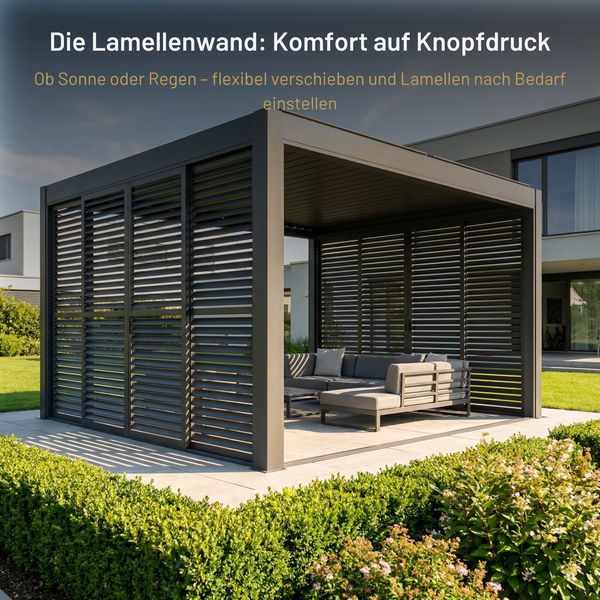
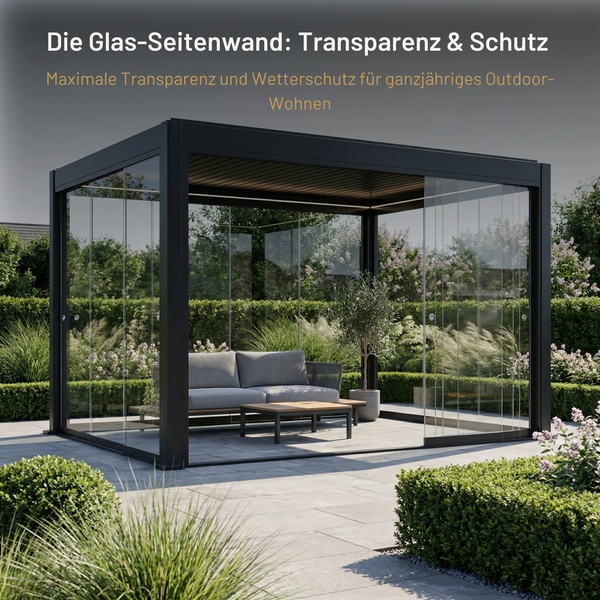
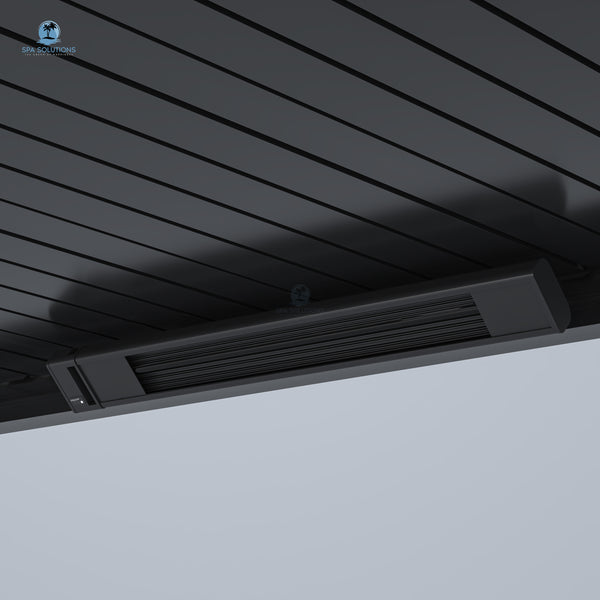
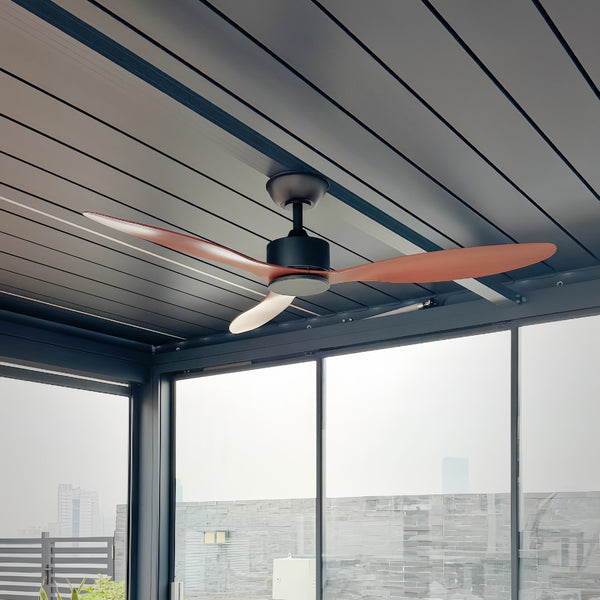
Colour and finish, a side blind, a glass side wall, a fixed louvre side element, a sliding louvre wall, integrated lighting, a heater, a fan, a speaker, and the way you operate the roof are all specified late in the process, and the LED retrofit kit is designed to be fitted into the frame of a pergola you already own, without an installer. If your budget is under pressure, that is where to economise, not on orientation. The UAE has a desert climate that is warm and sunny in winter and hot and humid in summer [9]; the case for powder-coated aluminium in exactly those conditions, along with the system background behind these options, is set out on the aluminium pergola overview for the UAE.
Why this ordering saves money
A badly oriented pergola is usually rescued by buying things: two or three side screens you had not planned, a heavier structure to gain depth, furniture moved to the one corner that still works. A well oriented pergola often needs fewer accessories than the brochure suggests, because the roof is already doing the work in the hours you actually use the terrace. Spending an afternoon measuring before you order is the cheapest part of the whole project.
One practical note before design starts: whether your community or building has rules about what may be built on a terrace or roof is a question for the party that administers your community or building, and for the responsible authority. Ask them, and have a qualified contractor confirm that the mounting surface can take the anchors, before the layout is frozen.
Aluminium pergola louvres north to south or east to west: what each does hour by hour
Fully closed, the two runs are equivalent. Overlapping blades form a sealed surface either way, and the direction they run in changes nothing. The run direction matters in every other position, and it matters most when the sun is low. That is the part competing guides leave out, and it is also the part you cannot revisit later.
Blades across the sun's track: narrow bands that travel
When the blades run across the direction the sun is coming from, a partly open roof produces narrow stripes of light that move steadily across the floor as the sun moves. The total amount of sun on the terrace may be modest, but no single spot stays reliably shaded for long. A dining table in that pattern gets a band of sun over one end, then over the other. This is the pattern people find most irritating in practice, and it is also why photographs of half-open louvre roofs look so attractive and feel so different to sit under.
Blades along the sun's track: a shade area that stays put
When the blades run roughly parallel to the direction the sun is travelling, a partly open roof lays down bands that stay in approximately the same place for hours and change mainly in width as the sun climbs or drops. That is far easier to live with, because you can place the seating under a band that holds. The cost is that this configuration gives you less control in the other axis.
The rule that holds, and its limits
The transferable physics is simple: a blade can only be angled against sun that comes from the direction its face can turn towards. Blades running north to south pivot on a north-south line, so their faces swing to the east and to the west. Blades running east to west pivot on an east-west line, so their faces swing to the north and to the south.
On this latitude the hours that ruin a terrace are the low-sun hours from the east in the morning and, far worse, from the west in the late afternoon, when the sun drives almost horizontally into the space and arrives when the day is already hot [1]. Only a north-south run can turn its full blade width against that sun. The high southern sun of the summer middle of the day does not need a clever angle, it needs the roof shut, and both runs shut equally well. A systematic review of 120 studies on hot arid and semi-arid Middle Eastern cities found that north-south oriented street canyons consistently outperform east-west configurations in reducing daytime heat stress, precisely because they are less exposed to low-angle solar radiation [2]. That research is about streets, not pergolas, so treat it as a direction of travel rather than a measurement of your terrace, but it points the same way as the geometry.
There is one honest exception. If your terrace is shaded by the villa for most of the day and your only real problem is the low southern sun at midday between November and February, an east-west run lets you angle the blade faces against exactly that sun. Some guides recommend east-west for south-facing terraces without saying why; this is the reason, and it is a narrow case rather than a general rule.
Ignore advice written for the southern hemisphere
Several of the most prominent pages on this question are written in Australia and advise tilting louvres towards the south for shade. South of the equator that is correct. On Dubai's latitude the midday sun stands in the south, so following that instruction opens your roof towards the sun you are trying to block. The same inversion applies to most European and North American placement guides, which treat a north-facing terrace as cool and pleasant and a south-facing one as a welcome source of winter warmth. On a latitude where the noon sun reaches close to the vertical in summer, that logic does not transfer.
| Aspect | Louvres running north to south | Louvres running east to west |
|---|---|---|
| Blade faces can turn towards | East and west | North and south |
| Low morning and late afternoon sun | Full blade width can be presented against it | Blades stay side-on; angling helps little |
| High summer sun at midday | Blocked by closing the roof | Blocked by closing the roof |
| Low southern sun at winter midday | Angling does not address it; needs a vertical element | Blades can be angled against it |
| Partly open shade pattern | Bands that travel across the floor through the day | Bands that stay roughly in place and change width |
| Whole-day heat balance in hot arid conditions | Better supported by the available research [2] | More exposed to low-angle radiation over the day [2] |
The sun path on this latitude, and why a flat roof loses in winter
Three numbers that define the year
The Emirates lie between 22 degrees 35 minutes and 26 degrees 25 minutes north latitude [10]. Dubai, at roughly 25 degrees north, sits just north of the Tropic of Cancer. At 25 degrees north the sun's altitude at solar noon is about 88.4 degrees at the summer solstice, about 65.0 degrees at the equinoxes and about 41.6 degrees at the winter solstice [3]. The swing between the solstices is about 47 degrees, because it equals twice the earth's axial tilt, and that is true at every latitude [4].
Round those to about 88, about 65 and about 42 degrees and you have the whole design problem in three numbers. In June the sun is almost overhead at midday and a horizontal roof is close to perfect. At the equinoxes, which is late March and late September, it is already a third of the way down. In December it is lower than 45 degrees, and a horizontal roof has almost nothing left to offer at midday.
What that means on the floor of your terrace
Take a pergola with a clear height of 2.5 metres and a depth of 3 metres from the southern edge to the northern edge. At solar noon the shadow of the southern roof edge falls to the north by a distance that follows directly from the sun's altitude. The numbers below are calculated from those altitudes [3] for that one example and ignore blade thickness and any shade from the house wall behind.
| Date | Noon sun altitude | Shadow of the southern roof edge falls north by | Depth of floor still shaded, of 3.0 m |
|---|---|---|---|
| Around 21 June | about 88 degrees [3] | 0.1 m | 2.9 m |
| Late March and late September | about 65 degrees [3] | 1.2 m | 1.8 m |
| Around 22 December | about 42 degrees [3] | 2.8 m | 0.2 m |
Read the last row again. At the winter solstice, at the best-shaded moment of the day, with the louvres fully closed, roughly 0.2 metres of a 3 metre deep floor remains in shade. The useful shade has moved 2.8 metres to the north of the pergola, where there is no roof. Nothing about the quality of the louvre system changes that; only a vertical element on the south side, or far greater depth, does.
The low-sun months are a side-on problem
The same mechanism governs mornings and afternoons all year. Near sunrise and sunset the sun sits low and comes in almost horizontally, sliding straight under any horizontal shading element, and it arrives when the day is already hot [1]. In Dubai solar radiation intensity reaches peaks of approximately 1,400 watts per square metre in summer [11], and measurements show irradiance occasionally exceeding 1,200 watts per square metre during the peak midday hours from 11:00 to 13:00 [12]. The midday figure is what a closed roof handles well. The low-angle version of that energy, arriving at eye level, is what a roof cannot handle at all.
The length of the day shifts the edges
Day length here swings by just over three hours across the year: 10 hours and 35 minutes on 22 December against 13 hours and 42 minutes on 21 June [13]. The earliest sunrise is at 5:28 in the morning on 9 June and the latest sunset at 7:13 in the evening on 3 July [14]. In summer the usable edges of the day therefore sit early and late, close to those two times, and in practice most people use the terrace near sunrise or well after sunset, while the middle of the day belongs to the air conditioning. In winter the whole usable day is short, which is why losing the midday hours to low southern sun hurts so much more than it would in July.
The season frame around all of this: the hot season lasts 4.3 months, from 14 May to 24 September, with average daily highs above about 38 degrees Celsius, and the cool season lasts 3.1 months, from 3 December to 5 March, with average daily highs below about 27 degrees Celsius [15]. Average summer highs sit around 41.8 degrees Celsius with overnight lows around 29.7 degrees Celsius, while winter highs average 23 degrees Celsius with lows of 14 degrees Celsius [16].
One conclusion worth stating plainly
Because Dubai sits at roughly 25 degrees north, which is north of the Tropic of Cancer, and because the sun's seasonal swing is bounded by the earth's axial tilt, which is half of that 47-degree swing [4], the midday sun here is always in the southern half of the sky. It never crosses to the north of the zenith. That is a conclusion drawn from the geometry rather than a measurement, and it applies to Dubai's latitude rather than to every site in the country, but it is the reason the north side of a structure here is the calmest aspect even in high summer and the south side is the one under load all year.
Your terrace by compass direction
West-facing: the hardest case
A west-facing terrace is pleasant all morning and then collapses. From mid-afternoon the sun arrives low, straight along the floor and straight into your eyes, and it does so in the hottest part of the day [1]. Closing the roof does not help, because the sun is not above you. Glare is as much of the problem as heat. This is the one aspect where a roof alone is never the answer, and where a retractable side blind on the western side is not an accessory but the main piece of equipment.
South-facing: a long midday window and a winter problem
A south-facing terrace is exposed for the longest continuous stretch of the day, but the sun is high for most of that stretch, which is exactly what a closed louvre roof handles best. In summer a south terrace under a closed roof is genuinely usable in the morning and evening and tolerable longer than people expect. From November to February the same terrace loses its midday hours to the low southern sun, as the shadow table above shows. A south terrace therefore needs the roof in summer and a vertical element on the south side in winter.
East-facing: the breakfast terrace
An east terrace takes low sun early, then falls into the shadow of the building behind it as the sun moves south and west, usually from around the middle of the day onward. In winter that makes it a morning-only space, because it goes cool and shaded for the rest of a short day. In summer it is the most practical aspect for early use, with sunrise as early as 5:28 in June [14] and a long, hot afternoon in full shade. A side blind on the eastern side extends the comfortable breakfast window.
North-facing: the quiet aspect
Because the midday sun on this latitude stays in the south, a north terrace gets no direct sun around noon at any time of year and only grazing sun at the extremes of a summer day. In winter, with average highs of 23 degrees Celsius [16], that makes it the most comfortable place for lunch in the house. In summer it is the aspect that suffers least. The trade-off is that it is also the darkest and, in the humid months, the least ventilated if it is boxed in by walls, with humidity averaging 59 per cent annually and peaking at 65 per cent in January and February [17].
| Terrace faces | Direct sun arrives | Main problem | What actually helps |
|---|---|---|---|
| West | Mid-afternoon until sunset | Low sun and glare at the hottest time of day | Side blind or sliding louvre wall on the west side; north-south louvre run |
| South | Most of the daylight hours | High sun in summer, low southern sun at winter midday | Closed roof in summer; vertical element on the south side from November to February |
| East | From sunrise to around midday | Low morning sun; cold and dark in winter afternoons | Side blind on the east side; accept it as a morning space |
| North | Only at the extremes of a summer day | Darkness and still air rather than sun | Open louvres for light and cross-ventilation; a heater on cool evenings |
Working the louvres through the day
Counter-rotation beats closing
Most advice reduces a louvre roof to two states, open and closed. The useful instruction is different: tilt the blades so their faces lean into the sun, not away from it. A blade angled towards the sun presents its full width to the incoming rays and casts the widest possible shadow, while leaving a gap above for hot air to escape. The same blade angled away from the sun presents an edge and lets light through the gaps. On a north-south run that means tilting towards the east in the morning and reversing the tilt towards the west after midday, rather than shutting everything. The bioclimatic louvre roof principle is exactly this: shade that adapts through the day rather than a fixed canopy.
Partial opening for cross-ventilation
Fully closing the roof in a humid August is often the wrong move. It gives you the deepest shade and simultaneously caps the space, so warm air accumulates underneath instead of rising out. A partly open roof, with the blades tilted into the sun rather than flat, keeps most of the shade and lets the hot air leave. Air movement matters because what you feel outdoors is dominated by radiant load rather than by air temperature, and field surveys in hot arid contexts record thermal acceptability ranges of 23 to 32 degrees Celsius in physiological equivalent temperature, markedly wider than European comfort standards assume [18]. People adapt, but only if the radiant load is handled and the air is moving.
Shade is not cooling, and it is not a substitute for sun protection
Two expectations need correcting before you order. First, a pergola does not lower the air temperature of your garden; it removes radiant load from the people and surfaces underneath it. The magnitude of that effect is large. Urban geometry that blocks the midday sky, with height-to-width ratios above roughly 0.6 to 0.8, cuts midday mean radiant temperature by 15 to 25 degrees Celsius [5], and dense tree canopies produce reductions of 20 to 30 degrees Celsius [6]. Those figures are measured on street canyons and tree shade, not on pergolas, so take them as the order of magnitude of what shading does rather than as a promise about your terrace. The mechanism is the transferable part: shade works by covering sky.
Second, shade is not a substitute for sunscreen. The World Health Organization's action guide to the ultraviolet index advises seeking shade during midday hours from index 3 to 7, and states that at index 8 and above being outside during midday hours should be avoided and shade is a must, alongside clothing, sunscreen and a hat [7]. The clothing and the sunscreen are listed in addition to shade, not instead of it.
Manual or motorised changes how often you really adjust
A counter-rotation strategy only works if adjusting is effortless. On a motorised roof such as the SkyMotion LED aluminium pergola you change the angle from a remote in a few seconds, and in practice you will do it three or four times a day. With a manual louvre roof you will realistically set it once in the morning and once in the afternoon, which is why a manual roof rewards getting the run direction right even more than a motorised one does.
When vertical elements are the real answer
Shading draws its effect from covering sky [5]. A roof covers the sky above you and leaves four sides open. For sun that arrives low, whether at winter midday or late on a summer afternoon, the open side is the whole problem, and no blade angle closes it. This is the point at which the conversation has to move from the roof to the sides.
West and east: the hours that decide usability
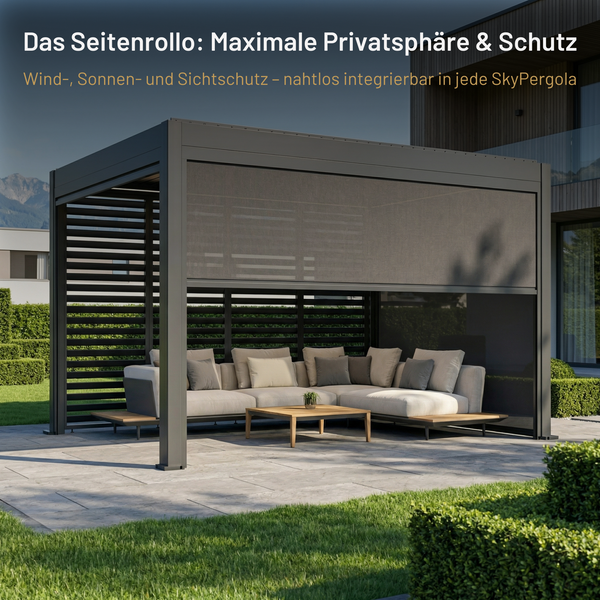
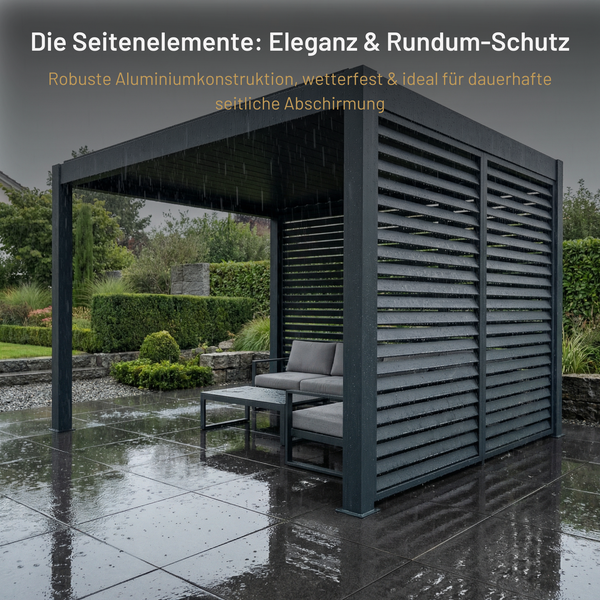
On a west-facing terrace a retractable side blind for the western elevation, from AED 5,175, usually turns the worst part of the afternoon into usable time. It blocks the low beam at the height it actually arrives, cuts glare, and rolls away when the sun has gone. A sliding louvre wall does the same job with an adjustable blade angle and keeps the view, and a fixed louvre side element suits a side you always want screened. These are the elements that should be budgeted from the start on a west or east aspect, not added as an afterthought.
South side in winter
For the November to February midday problem on a south terrace, the vertical element goes on the south side and only needs to be there for a few months. A retractable screen is the better fit than anything fixed, because for the rest of the year that side is where your light and your breeze come from.
Planting as the third option
Where you have ground to plant, dense overhead greenery produces the largest radiant-temperature reductions in the reviewed studies: tree canopies, linear green corridors and clustered planting are the configurations that attenuate radiant heat most strongly [6]. Planting on the west side of a terrace works with a pergola rather than against it, because it intercepts the low sun that the roof cannot. It takes years to mature and it needs water, which is the honest counterweight.
Surface and colour: glare from light soffits, heat in dark profiles
Why colour is not only a style question
Surface colour changes surface temperature dramatically. A clean white surface reflecting 80 per cent of sunlight stays about 31 degrees Celsius cooler than a grey surface reflecting only 20 per cent [19]. Two surfaces can even look identical and differ substantially: a cool-coloured surface reflecting 35 per cent of sunlight stays about 12 degrees Celsius cooler than a traditional surface that looks the same but reflects only 10 per cent [20]. Those measurements come from roof research rather than from pergola soffits, so read them as the scale of the effect between surfaces of different reflectance, not as a figure for your louvres.
The trade-off nobody mentions
A light underside stays cooler and makes the space under the roof brighter, which is welcome on a north aspect. It also reflects. High-albedo, highly reflective surface treatments lower surface temperatures but can increase reflected radiation and actually raise the mean radiant temperature people experience if they are not combined with shading elements [21]. On a west terrace, a bright soffit catching low afternoon sun becomes a glare source directly in your sightline.
A dark profile does the opposite: less glare, a calmer visual field, a noticeably darker space underneath, and a frame that gets considerably hotter in direct sun. On a pergola the heat matters less than it would on a roof, because the hot surface is above you and the frame is aluminium rather than a heat store, but you will feel it if you touch a sunlit post at three in the afternoon.
What this means in practice
On a west or south aspect, a mid to dark tone on the underside usually reads more comfortably because glare is the dominant complaint. On a north or east aspect, where the space can feel gloomy, a lighter tone is the better choice. On Sky Pergola models the posts, beams and louvres share the same colour, so this is a single decision for the whole structure rather than a combination to assemble. It is also the choice with the least consequence for shade, which is why it belongs after the run direction, not before it.
Measure it yourself: a one-day shadow log before you order
You do not need software or a consultant for this. You need a phone, one day, and ten minutes three times during that day. The output is a set of facts about your own terrace that no generic guide can give you.
Step by step
- Find true north. Open a compass app and stand at the centre of the proposed pergola footprint, away from metal railings and air-conditioning units. A compass does not point to geographic north; it points along the magnetic force at your location, which usually differs from geographic north, and that difference changes with place and time [22]. For Dubai the World Magnetic Model gives a declination of about 2.24 degrees east for late 2026 [8], and the current model release, WMM2025, is valid until late 2029 [23]. Two degrees is well inside the tolerance of pergola planning, so your phone reading is good enough as it stands. Write down the direction your terrace faces in degrees.
- Photograph at three fixed times. Take the same framing three times from the same spot: roughly two hours after sunrise, as close to solar noon as you can manage, and roughly two hours before sunset. Include the floor, the house wall and the furniture in every shot. Note the time on each.
- Mark the shade edges. On each occasion, lay a tape or a line of objects along the boundary between sun and shade on the floor and measure how far it sits from the house wall. Three numbers from three times of day tell you more about your terrace than any catalogue.
- Run the shadow check. Stand in the open at each of the three times and look at your own shadow. The US Environmental Protection Agency builds this into its ultraviolet index advice: if your shadow is shorter than you are tall, seek shade and wear protective clothing, a wide-brimmed hat and sunglasses [24]. The rule is pure geometry and works anywhere. A shadow shorter than your height means the sun is high and a roof will do the work; a shadow far longer than your height means the sun is low and only a vertical element will.
- Repeat once in the opposite season if you can. A log taken in January and a log taken in June describe two different terraces, because the noon sun moves about 47 degrees between them [4].
Digital tools and their limits
Sun path calculators are a useful cross-check on a shadow log but not a replacement for it, because they know nothing about your neighbour's wall or your villa's parapet. If you use one, check that it is current: the widely used NOAA solar position calculator is no longer actively supported or maintained, its results are theoretically accurate to within a minute for locations between 72 degrees north and south latitude, and the underlying spreadsheet calculations are only valid for dates between 1901 and 2099 [25].
What to bring to the planning conversation
- The direction your terrace faces, in degrees, taken with a compass app at the footprint centre.
- Your three photographs with times, and the three measured distances from the wall to the shade edge.
- The hours you actually want to use the space, named as clock times, and for which months.
- Which problem you want solved first: glare, radiant heat, privacy, wind or dust.
- Whether the space must work at midday in December, which is the single hardest requirement and the one that decides whether vertical elements are optional.
- Any constraint on post positions, and what the mounting surface is (concrete, tile, decking or parapet).
Matching your findings to an aluminium pergola model
Once you know your aspect and your target hours, the model choice follows from depth, control and how much of the sky you want to be able to open. The technical background to the rotating roof itself is set out on the louvre roof pergola page for Dubai.
If your shadow log shows that you need real depth on a west or south aspect, span is what buys you shade: the SkyMax Ultra aluminium pergola is built at 4 by 6 metres with motorised, illuminated louvres and a wind resistance of up to 120 kilometres per hour, which keeps the covered area deep enough to hold shade as the sun drops. Where the terrace is dark in winter and hot in summer, the ability to clear the roof matters more than depth: the SkyInfinity Pro aluminium pergola has a fully retractable louvred roof that opens up to 70 per cent, in sizes from 3 by 3 to 4 by 6 metres, so a north terrace can be opened to the sky in January and closed in July.
For a compact seating area where you will adjust the angle several times a day, the SkyMotion LED model at 3 by 3 metres, from AED 28,755, gives you motorised blades and integrated lighting in the frame. If you would rather put the budget into the vertical elements your log says you need, the SkyLite ECO aluminium pergola at 3 by 3 metres, from AED 21,555, has a manual louvred roof and integrated LED, and leaves room for a side blind on the aspect that matters. All of these models are rainproof with an integrated drainage system through the louvres, gutters and posts; in extreme storms, water can still enter in places because of how an opening roof is constructed, which is worth knowing in a winter where accumulated rainfall reaches 87.3 millimetres a year and falls mainly in the winter months [17].
On the motorised models the motor sits out of sight in the beam and the lighting is integrated inside the frame, directed downwards, so neither adds anything to the shadow pattern you measured.
The short version, and where to start
If you remember one thing, make it this: get the louvre run and the rotation right, because they are the only parts you cannot buy your way out of later. For the great majority of UAE terraces, run the blades north to south, so their faces can be turned against the low eastern and western sun that does the real damage [1][2]. Choose an east-west run only in the narrow case where low southern sun at winter midday is your single problem.
Then accept the limit of any flat roof honestly. From October to March the noon sun on this latitude stands low enough that the shade of the roof simply moves off your floor, as the shadow table above shows. If you want the terrace to work at midday in those months, a vertical element on the exposed side is not an upgrade, it is the mechanism. And expect the right things from the result: a large reduction in radiant load rather than cooler air [5][6], with clothing and sunscreen still sensible at high ultraviolet index values [7].
Do the one-day shadow log first. Then take your three photographs, your compass reading and your target hours into the Sky Pergola configurator and set the size and orientation against real numbers from your own terrace. If anything in your log is ambiguous, send us the photographs and measurements before you fix the layout.
Frequently asked questions
Should pergola louvres run north-south or east-west?
For most UAE terraces a north-south run is the better default. Blades running north to south pivot so their faces turn east and west, which is where the low, hard sun comes from, driving almost horizontally under any roof[1]. Research on hot arid cities also favours north-south orientation for the daytime heat balance[2]. Pick an east-west run only if your single problem is the low southern sun at midday in winter.
Does louvre run direction still matter if the louvres are motorised and rotate?
Yes, though less than people assume. Fully closed, both runs block the same sun. The run direction only matters in partial positions and against low sun, because a blade can only be angled towards the direction its face can turn. Motorisation lets you change the angle in seconds; it does not change the axis. A north-south run can be angled against eastern or western sun, an east-west run against southern sun.
Why is my terrace still sunny in winter even with the louvres fully closed?
Because the sun is no longer above you. In late December the noon sun on this latitude stands at only about 42 degrees[3]. For a roof 2.5 metres above the floor, the shadow of the southern roof edge is pushed about 2.8 metres north, so of a 3 metre deep floor only around 0.2 metres stays shaded at noon. A horizontal roof cannot fix that; a vertical element on the south side can.
What can I do about a west-facing terrace that is unusable in the late afternoon?
Treat it as a vertical problem. The late sun arrives low and almost horizontally, at the hottest point of the day[1], so no blade angle intercepts it. A retractable side blind on the western elevation, from AED 5,175, or a sliding louvre wall blocks the beam at the height it actually arrives and cuts the glare, then rolls or slides away once the sun has set.
Is my phone compass accurate enough for pergola planning in Dubai?
Yes. A compass points along the magnetic force at your location rather than to geographic north, and the difference varies with place and time[22]. For Dubai the World Magnetic Model gives a declination of about 2.24 degrees east for late 2026[8], from the current model release, valid until late 2029[23]. Two degrees is far inside planning tolerance. Just stand away from railings, cars and air-conditioning units when you take the reading.
Which pergola colour is best for heat in the UAE?
There is a genuine trade-off. Reflectance changes surface temperature substantially: a surface reflecting 80 per cent of sunlight stays about 31 degrees Celsius cooler than one reflecting 20 per cent[19]. But highly reflective treatments can increase reflected radiation and raise the radiant temperature people feel if they are not combined with shading[21]. Lighter tones suit north and east aspects, darker tones reduce glare on west and south. Posts, beams and louvres share one colour.
Does a pergola reduce the temperature underneath, or only block the sun?
Mainly it removes radiant load rather than cooling the air. Shaded urban geometry cuts midday mean radiant temperature by 15 to 25 degrees Celsius, and dense tree canopies by 20 to 30 degrees Celsius[5][6]. Those figures come from streets and trees, not pergolas, so read them as the scale of the effect. Air temperature still follows the day, with summer highs averaging around 41.8 degrees Celsius[16], so airflow matters as much as shade.
Can the pergola be rotated or re-oriented after it is installed?
Not realistically. The posts are anchored into your surface and the beams carry the blades on one fixed axis, so changing the rotation or the louvre run means dismantling the structure and building a new foundation. That is why these two choices deserve your time before ordering, while colour, side blinds, glass walls, lighting, heating and controls can all be decided later in the process.
Sources
- Sun Path & Solar Geometry – Studio Matrx
- Outdoor thermal comfort in hot arid and semi-arid MENA cities: a systematic review – Frontiers in Sustainable Cities
- Solar Altitude and Azimuth Explained – Harth
- Sun Path & Solar Geometry – Studio Matrx
- Outdoor thermal comfort in hot arid and semi-arid MENA cities: a systematic review – Frontiers in Sustainable Cities
- Outdoor thermal comfort in hot arid and semi-arid MENA cities: a systematic review – Frontiers in Sustainable Cities
- Radiation: The ultraviolet (UV) index – World Health Organization (WHO)
- Geomagnetic field model web service (World Magnetic Model) – British Geological Survey (BGS)
- Fact sheet – The United Arab Emirates' Government portal (u.ae)
- Fact sheet – The United Arab Emirates' Government portal (u.ae)
- Sustainable cooling solutions in Dubai: the impact of incident radiation and panel angles on solar AC performance – Scientific Reports (Nature Portfolio), via PubMed Central
- Sustainable cooling solutions in Dubai: the impact of incident radiation and panel angles on solar AC performance – Scientific Reports (Nature Portfolio), via PubMed Central
- Dubai Climate, Weather By Month, Average Temperature (United Arab Emirates) – Weather Spark (Cedar Lake Ventures, Inc.)
- Dubai Climate, Weather By Month, Average Temperature (United Arab Emirates) – Weather Spark (Cedar Lake Ventures, Inc.)
- Dubai Climate, Weather By Month, Average Temperature (United Arab Emirates) – Weather Spark (Cedar Lake Ventures, Inc.)
- Geographic Location & Climate – Dubai Government Media Office
- Geographic Location & Climate – Dubai Government Media Office
- Outdoor thermal comfort in hot arid and semi-arid MENA cities: a systematic review – Frontiers in Sustainable Cities
- Cool Roofs – Lawrence Berkeley National Laboratory, Heat Island Group
- Cool Roofs – Lawrence Berkeley National Laboratory, Heat Island Group
- Outdoor thermal comfort in hot arid and semi-arid MENA cities: a systematic review – Frontiers in Sustainable Cities
- World Magnetic Model (WMM) – NOAA National Centers for Environmental Information (NCEI)
- World Magnetic Model (WMM) – NOAA National Centers for Environmental Information (NCEI)
- UV Index Scale – United States Environmental Protection Agency (EPA)
- Solar Calculation Details – NOAA Global Monitoring Laboratory
Last updated: October 2026


