
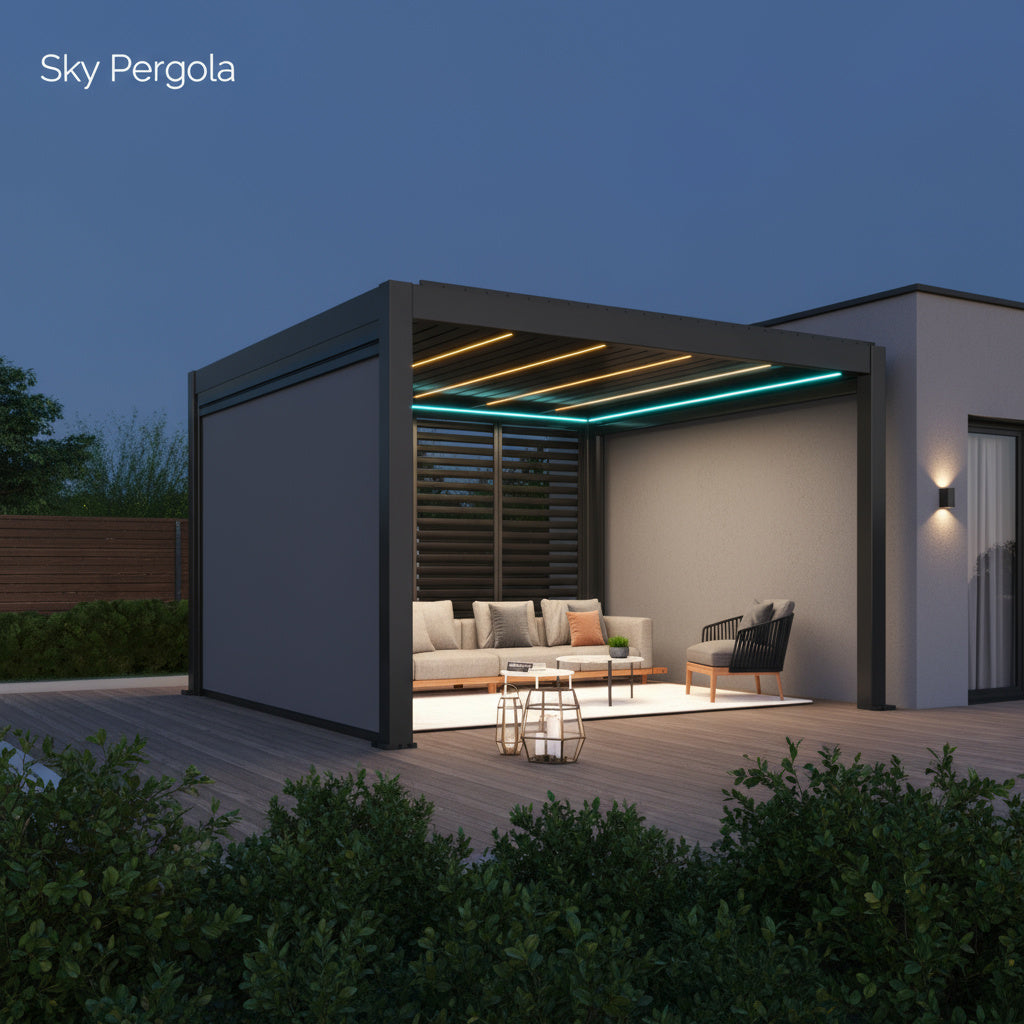
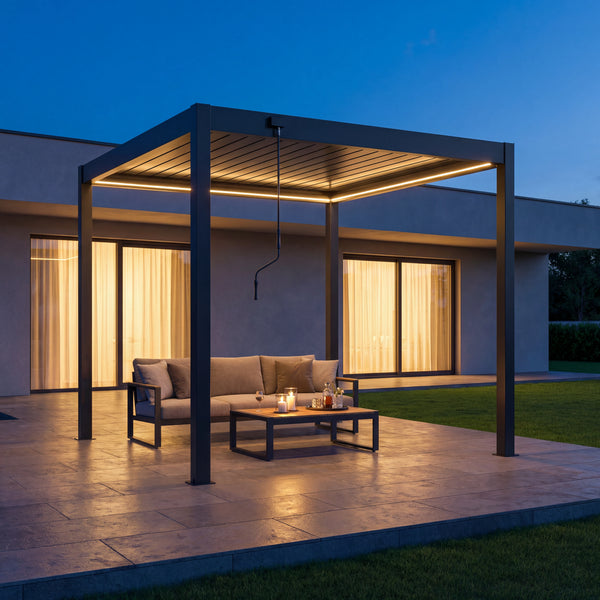

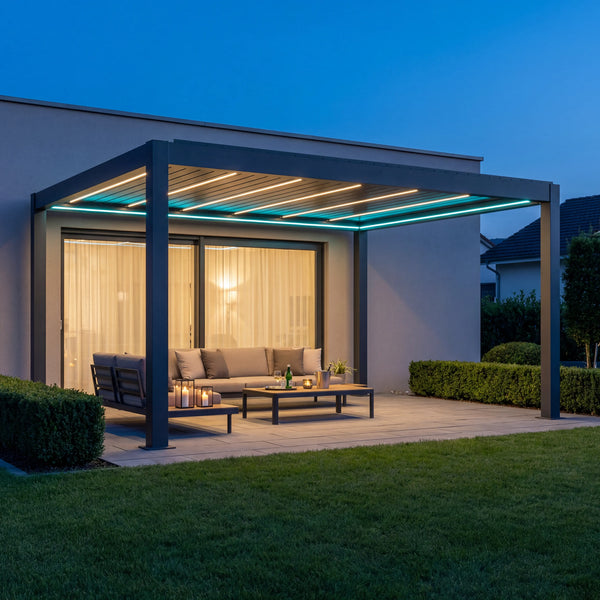












Whether as a freestanding structure in the garden or as a stylish extension of the terrace – a pergola must not only be visually appealing, but also meet the highest technical requirements.
Proper pergola structural design ensures long-term stability and protects against weather-related damage. This article explains which structural factors are crucial for a secure foundation, what loads act on the structure, and why professional structural design is so important for a pergola.
-
A precise structural analysis is essential for the safety of a pergola: loads such as dead weight, wind, snow and accessories must be realistically modeled and safely transferred to the ground via suitable materials and statically dimensioned connections.
-
The choice of material directly influences the load-bearing capacity and longevity of the construction: aluminum impresses with high stability at low weight, large spans and ease of maintenance, while wood requires stronger cross-sections, more frequent maintenance and lower weather resistance.
-
A stable foundation and professional planning protect against damage and ensure approval: Professional anchoring, consideration of climatic conditions (e.g. snow load) and compliance with legal standards (such as SIA) prevent construction errors and preserve long-term stability.
What needs to be considered when calculating the statics of a pergola?
Precise structural calculations are crucial to ensure that a pergola remains stable even under fluctuating loads. A structural system forms the basis for realistically calculating all forces, such as dead weight, wind, and any additional loads, and transferring them effectively into the ground.
The load model is usually created using modern CAD software. Material selection, cross-sections, and connection points are coordinated to ensure that the entire pergola structure is evenly loaded. Only when all influencing factors are correctly calculated will the required load-bearing capacity be achieved.
A complete planning process also includes the review of this model by experienced structural engineers. In addition to computational methods, graphical or practical procedures are sometimes used to simulate the behavior of the structure under everyday conditions.
A structural design according to valid standards such as the Swiss SIA not only ensures the project complies with building regulations, but also forms the basis for risk mitigation. The following points are particularly relevant in this regard:
-
Realistic recording of all loads, including accessories
-
Consideration of the exact material behavior
-
Avoidance of stress or strain peaks
-
unambiguous force introduction into the foundation or wall
Building physics provides the basis for this planning. If it is neglected in the process, structural stability cannot be guaranteed in the long term. Professional design prevents small calculation errors from causing major damage.
What loads act on a pergola?
A pergola is subject to various forces that must be considered early in the planning process. Besides its own weight, these include wind loads, snow loads, and additional loads such as vegetation or technical equipment. Each of these loads alters the distribution of forces within the structure.
Especially in winter, snow load can pose a challenge. At higher altitudes, heavy snowfall can quickly lead to accumulations of over 500 kilograms per square meter. This load presses vertically onto the roof, placing high demands on the supports and the roof surface.
If the load-bearing capacity is insufficiently dimensioned, damage to important components is likely.
Not only the quantity but also the direction of the force is crucial. Vertical loads such as snow act on supports and foundations. Horizontal forces such as strong winds, on the other hand, alter the stress behavior at connection points and cross braces. These differences necessitate a targeted selection of materials and connections.
-
Vertical loads stress columns, beams and foundations directly from above.
-
Horizontal forces act laterally on the structure and endanger nodes.
-
Snow loads can occur as localized pressure peaks.
-
Gusts of wind create short-term suction or pressure effects from the side.
Wind loads, in particular, can occur suddenly and cause strong forces. Without stable connections and a well-anchored base, the entire pergola can shift or deform. To ensure the long-term structural stability of a pergola, it requires reinforced support profiles, durable connecting elements, and a secure anchoring in the ground.
How do materials like aluminum and wood affect the structural integrity?
The choice of material is crucial to the structural integrity of any pergola. Aluminum, with its low weight combined with high load-bearing capacity, offers excellent conditions for achieving large spans with slim profiles. The structure remains stable, even in wind and snow. Its shape remains reliably consistent, which is a real advantage for freestanding or wide structures.
Wood behaves differently. It is heavier, less dimensionally stable, and more susceptible to moisture and temperature fluctuations. These influences can cause the material to deform, which compromises structural stability. To achieve similar spans to aluminum, wood often requires thicker cross-sections. A common guideline is five centimeters of beam cross-section per meter of span.
Aluminum also excels in terms of durability. It is corrosion-resistant, does not rust, and requires minimal maintenance. This makes aluminum pergolas the preferred solution for a permanently stable outdoor structure.
Wood, on the other hand, requires regular protective coatings and has a noticeably shorter lifespan. Its stability deteriorates more quickly, especially under harsh weather conditions. Where stylish design needs to be combined with technical reliability, the superiority of aluminum becomes particularly evident.
A direct comparison :
-
Aluminum: high load-bearing capacity, low deformation, large span possible
-
Wood: reacts to humidity and temperature; only limited spans are achievable.
-
Aluminum: easy to care for, corrosion-resistant, durable
-
Wood: high maintenance, sensitive to weather changes, shorter lifespan
Foundation and anchoring: The basis of every stable pergola
For the structural stability of any pergola, a direct and load-bearing connection to the ground is essential. A stable foundation ensures that all forces are reliably transferred into the ground, thus preventing subsequent settling or unwanted tipping.
Particular attention must be paid to the anchoring. It keeps the structure in place, even in gusts of wind or unexpected additional loads. A sufficiently strong base plate ensures that the forces are not only distributed evenly but also securely absorbed laterally. Crucially, the dowels or anchors must be suitable for the load and the soil composition.
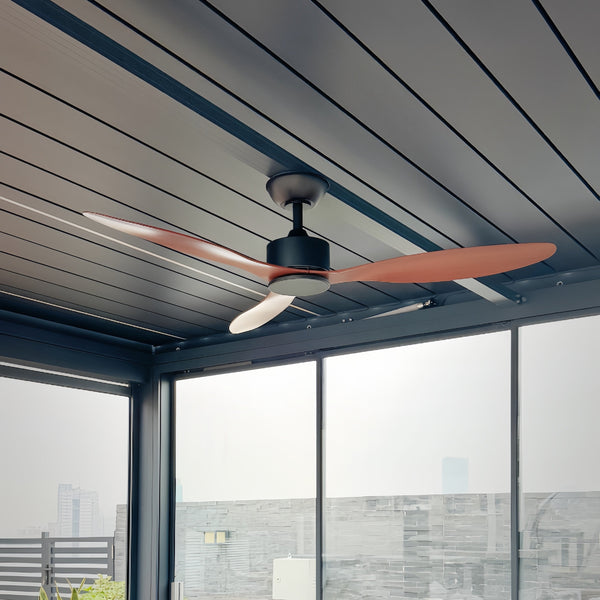
Technical components such as movable louvers, LED systems, or sensors increase the weight and place additional demands on load transfer. Those planning to install this equipment must pay particular attention to sufficient foundation depth and stable force transmission.
Depending on the soil conditions and position, various solutions are possible for fastening :
-
Direct anchoring with concrete anchors in the base plate
-
Use of heavy-duty anchors in existing concrete foundations
-
Chemical anchoring for stable wall connections
-
Point foundations for irregular or soft subsoil
Professional planning instead of DIY – safety through expertise
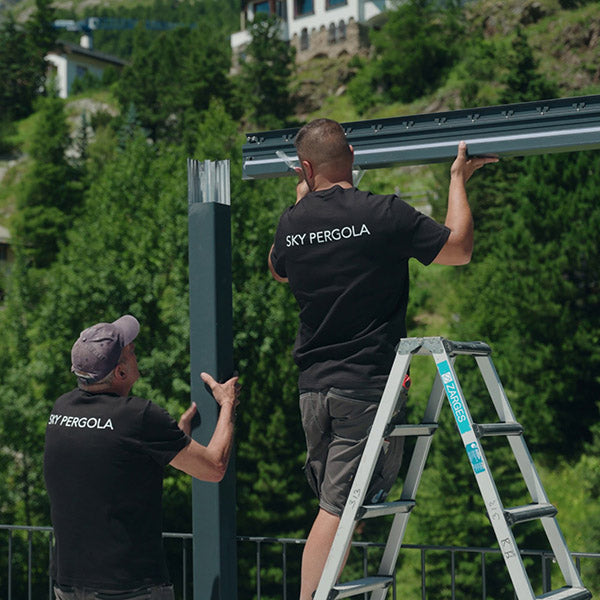
Without expert structural engineering knowledge, building a pergola yourself carries significant risks. Accurate calculation of support dimensions, load distribution, and foundation design requires in-depth knowledge. Without this foundation, structural defects can result, impacting stability and lifespan.
Common construction errors in self-build projects :
-
Foundations lacking sufficient load-bearing capacity
-
Spans too long for the material used
-
insufficiently secured connection points
-
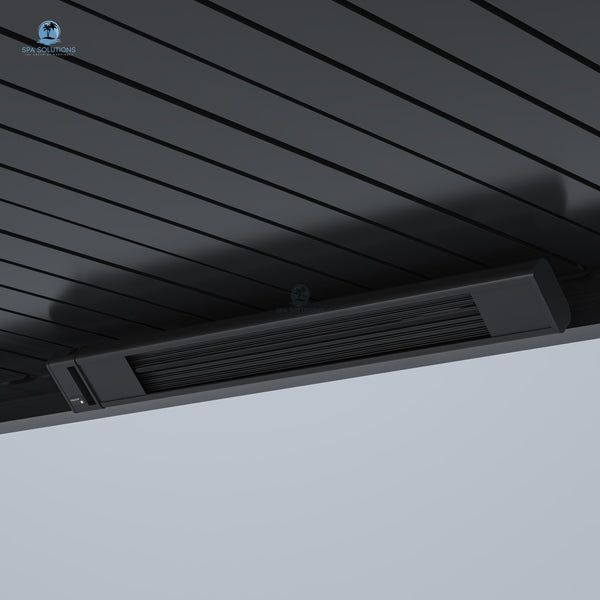
Unforeseen additional costs due to accessories such as glass roof, radiant heater or lighting
These points are often the cause of structural failure or material deformation. Anyone wanting to build a pergola themselves easily underestimates the complex influences on the statics of a patio roof, especially with custom features.
Only a well-thought-out, professional plan takes all relevant parameters into account. It ensures sufficient structural reserves, defines the correct connecting elements, and guarantees that the entire system can withstand long-term demands. This significantly improves not only the construction quality but also the service life and safety of the pergola.
Building permit: Is a structural analysis required?
In most municipalities, the construction of a pergola requires a permit. As part of the building permit process , the responsible authority typically requires complete documentation of the pergola's structural integrity. Only if this documentation complies with the relevant building regulations can the construction project be approved. Failure to submit a building application not only jeopardizes the progress of construction but can also have legal consequences.
These include, among other things :
-
a dismantling obligation for the entire structure
-
Administrative penalties for violations of the building code
-
Liability risks in case of personal injury or property damage
Knowing all the requirements early on and having the necessary documents prepared by a professional creates the best conditions for a smooth approval process. Clarifying the structural requirements early is particularly worthwhile for permanent structures with a roof, foundation, or additional features. A correctly submitted building application not only protects the structure itself but also comprehensively safeguards you as the owner from unexpected consequences.
Care and maintenance: What role does maintenance play in structural stability?
Regular maintenance is crucial for the long-term stability of a pergola. Neglecting dirt, fasteners, or drainage can compromise the entire structure. Taking maintenance seriously protects not only the materials but also the structural integrity.
When it comes to material maintenance, aluminum requires minimal effort and remains corrosion-free for many years. Wood, on the other hand, is more sensitive and requires a regular maintenance cycle. This includes treatment against UV radiation and regular surface refinishing. Only in this way can dimensional stability and load-bearing capacity be ensured in the long term.
In winter, special attention is needed to prevent snow loads and ice formation early on. These seasonal measures ensure functionality and prevent structural damage. A seasonally coordinated maintenance plan is helpful , which includes the following points:
-
Remove snow from the pergola immediately after heavy rainfall.
-
Check that moving parts are free of ice.
-
Clean gutters and drains regularly.
Those who consistently implement these measures ensure that the stability of the pergola is not affected even under challenging weather conditions.
How do you protect a pergola from wind and weather?
Strong gusts of wind act laterally on the structure and can overload unstable connections. To counteract these forces, a robust mounting profile and permanently anchored support elements are crucial. Wall connections must be positioned precisely so that the entire windbreak structure has a clean, defined line.
In windy regions, aluminum proves to be a particularly effective material. It doesn't warp, remains dimensionally stable, and has a low weight. Sky Pergola offers storm-proof models specifically designed for such conditions, capable of withstanding wind speeds of up to 120 km/h.
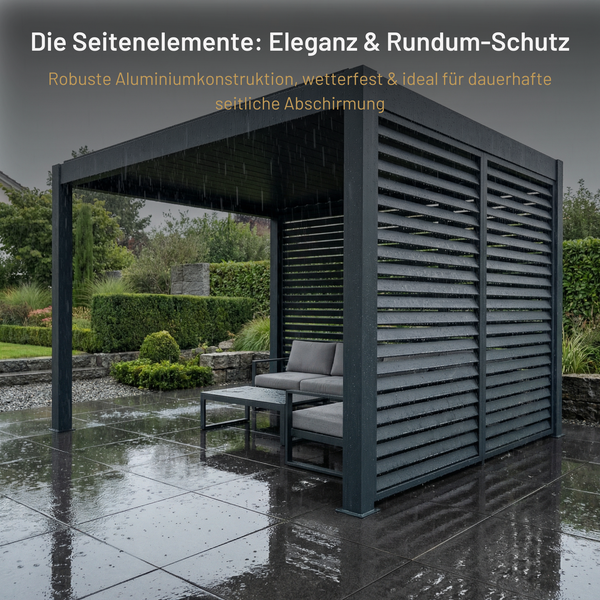
Additional components, such as solid side walls, contribute to storm resistance. They reduce lateral forces and stabilize freestanding structures against tilting. A well-designed pergola structure incorporates these elements from the outset.
-
Stable mounting profiles for structural reinforcement
-
Precisely placed wall connections for safe force transmission
-
Sidewalls against lateral wind pressure
-
Reinforced connection points around node areas
Safe pergolas from Sky Pergola
 Opt for maximum stability and Swiss quality: At Sky Pergola you not only get stylish pergolas, but also technically perfectly planned pergolas including professional structural analysis and assembly.
Our models are available immediately, customizable, and specifically designed to withstand the challenges of wind and weather in Switzerland. Benefit from fast delivery, expert advice, and first-class customer service. Start your project now – schedule your personal consultation with Sky Pergola!
Frequently asked questions about pergola statics
What loads must be taken into account when calculating the statics of a pergola?
When calculating the structural integrity of a pergola, its own weight, wind loads, snow loads, and additional loads such as plants, technical equipment, or side walls must be taken into account. Vertical loads act on supports and foundations, while horizontal forces—such as wind—stress the connection points and cross braces. A complete structural analysis considers all these factors for a safe, long-term stable construction.
Why is snow load a crucial factor in the structural design of a pergola?
In regions with heavy snowfall, a considerable roof load can accumulate. Especially with shallow roof pitches, the snow remains longer and exerts high pressure on the supporting profiles. The structural design of a pergola must therefore be adapted to the specific region – with reinforced supporting elements, sufficient slope, and efficient drainage to safely dissipate the snow load.
How does the material affect the statics of a pergola?
The material used has a significant impact on the structural load-bearing capacity. Aluminum is particularly suitable for large spans because it is lightweight, dimensionally stable, and corrosion-resistant. Wood, on the other hand, is heavier, more susceptible to deformation due to moisture and temperature, and requires larger cross-sections to bear the load. Those seeking a stable, long-term solution will benefit from the advantages of aluminum in the structural design.
What role does the foundation play in the statics of a pergola?
A stable foundation is essential for the safety and longevity of the pergola. It ensures that all forces – such as those from wind or snow – are reliably transferred into the ground. Depending on the subsoil, point foundations, base plates, or chemical anchoring systems are used. Professionally planned anchoring prevents tipping or settling.
Is a structural analysis also necessary for smaller pergolas?
Yes. Even smaller pergolas are subject to stress from wind, snow, and accessories. A precise structural analysis provides the necessary proof that the structure can withstand these loads permanently. In many municipalities, a building permit including a structural analysis is also mandatory – regardless of the size of the structure.


