
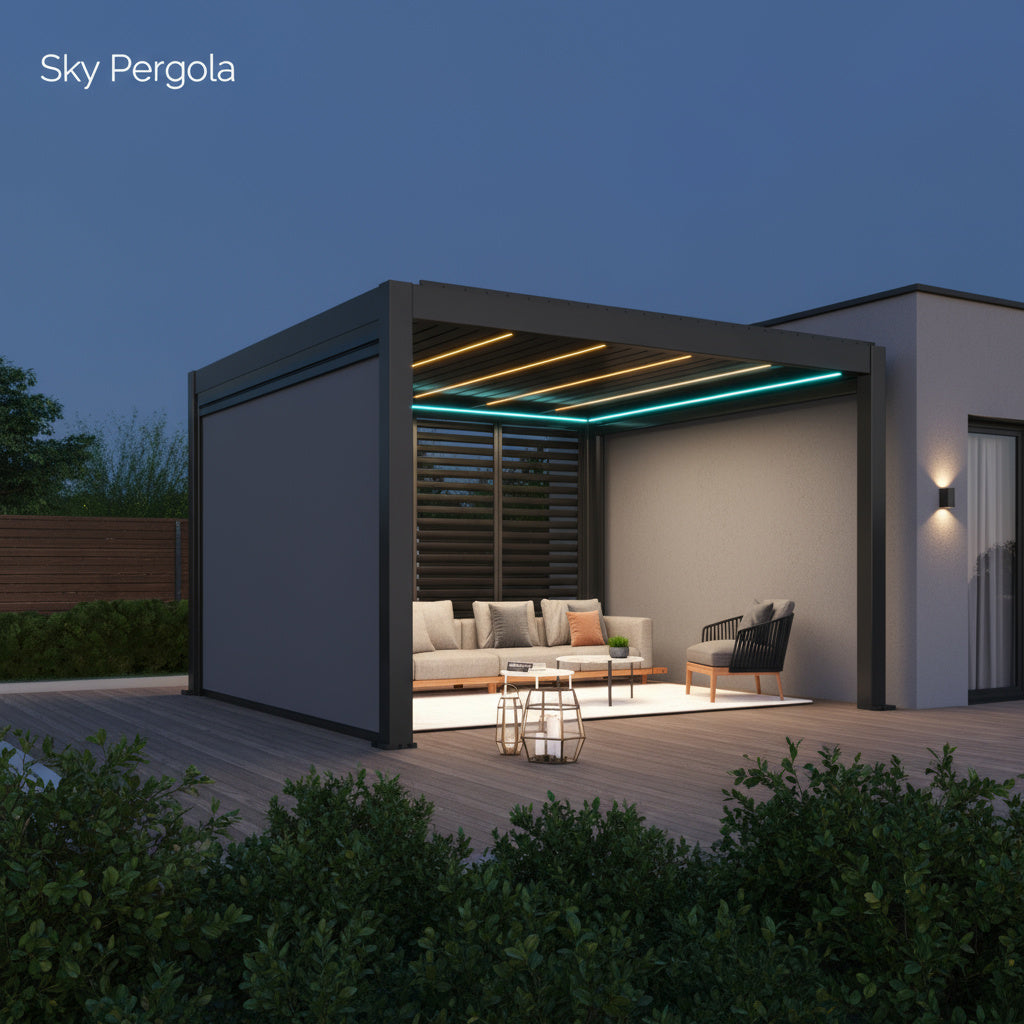
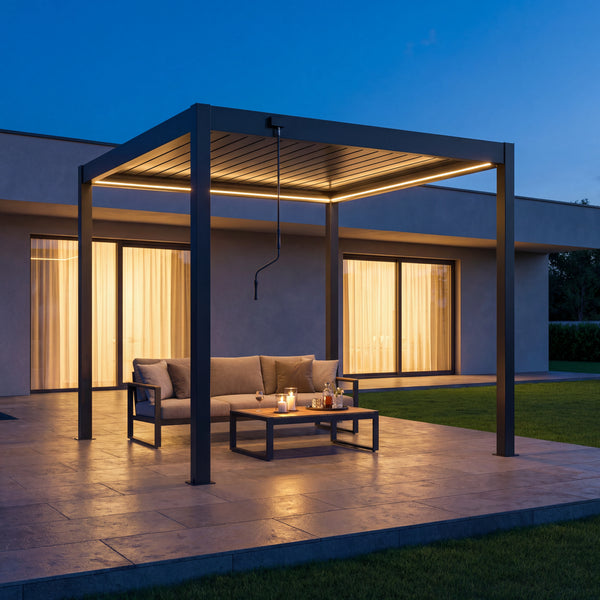
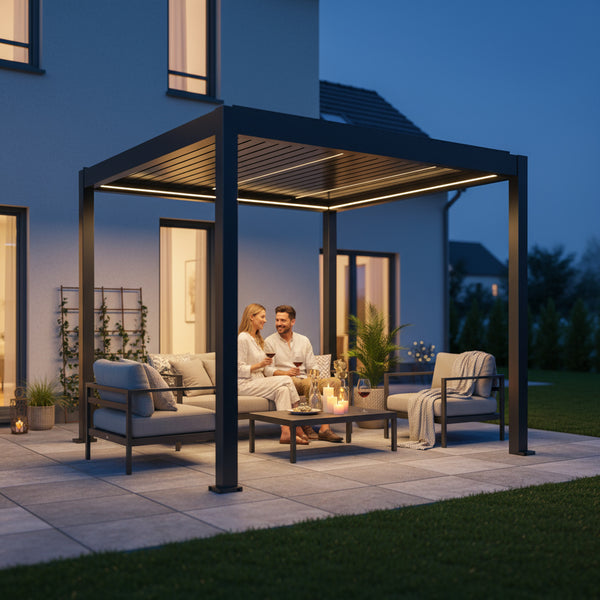
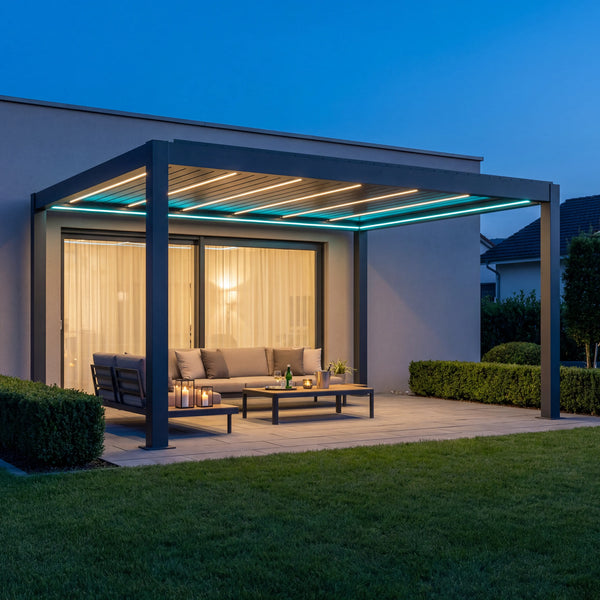






Pergola made of steel or aluminum? Anyone planning a high-quality terrace roof will sooner or later face this question – and it’s justified, because the material determines lifespan, maintenance effort, and ultimately the price. Steel appears robust and solid at first glance, aluminum scores with lightness and rust resistance. But which material really suits your terrace?
In this honest material comparison, we look at aluminum, steel, and – briefly – wood as well. We examine weight, corrosion, maintenance, load capacity, appearance, price, and lifespan. And we openly tell you where steel is actually superior and why, as a Swiss manufacturer, we still consistently rely on powder-coated aluminum.
The Three Materials at a Glance
Before we go into detail, it’s worth looking at the basic properties. Every material has its strengths – and its weaknesses, which become visible outdoors over the years.
| Criterion | Aluminum | Steel | Wood |
|---|---|---|---|
| Weight | Very light | Very heavy | Medium to heavy |
| Corrosion / Rust | Rust-free | Rust-prone without protection | Rot / Weathering |
| Maintenance | Very low | Regularly required | High (painting, oiling) |
| Load capacity | High | Very high | Medium |
| Appearance | Modern, sleek | Solid, industrial | Natural, warm |
| Price | Medium to high | Medium | Low to medium |
| Lifespan | Very long | Long (with maintenance) | Limited |
Weight: Why Every Kilogram Counts
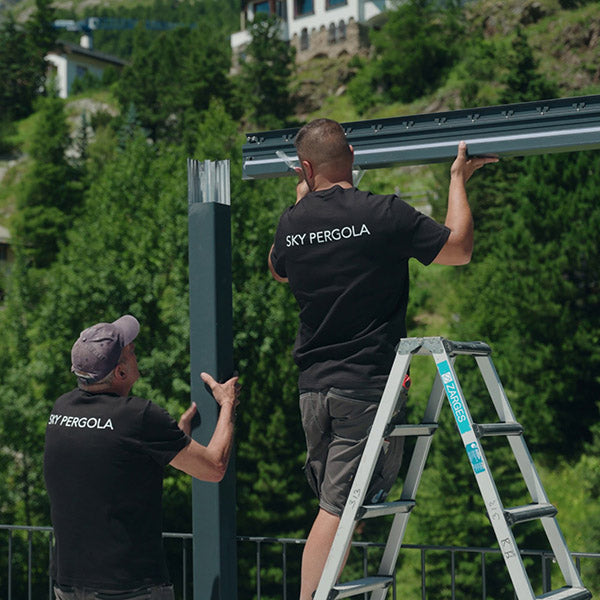
Aluminum is about one-third the weight of steel. That sounds like a pure number, but it has noticeable consequences. A lightweight construction is easier to install, puts less strain on the facade and foundation, and is more flexible in placement – also on balconies or roof terraces, where structural stability quickly becomes an issue.
Steel brings significantly more mass. This is not inherently bad, but it requires a more robust foundation and usually more effort during installation. This is relevant for a freestanding terrace roof with large spans.
Corrosion and Rust: The Decisive Long-Term Factor
Here lies the biggest practical difference. Aluminum forms a natural oxide layer in the air that protects the material from further corrosion – it simply does not rust. Combined with a powder coating, the surface is additionally sealed against UV radiation, rain, and dirt.
Steel, on the other hand, rusts as soon as the protective layer is damaged. Galvanized or coated steel lasts a long time, but every scratch, every chipped piece of paint is a potential point of attack – especially on a pergola exposed to wind and weather all year round. Wood, in turn, struggles with moisture, rot, and fungal infestation.
Maintenance: How much work does your pergola require?
Anyone who wants to relax under the pergola in summer doesn’t want to plan maintenance work. This is exactly where aluminum shows its strength.
- Aluminum: Occasional wiping with water is enough. No painting, no rust protection, no re-treatment.
- Steel: Regularly check protective coating, repair rust spots, repaint if necessary.
- Wood: Sanding, oiling, or staining every few years – otherwise the material grays and weathers.
Over ten or twenty years, maintenance effort for steel and wood adds up significantly. Aluminum remains almost maintenance-free.
Stability and load capacity: steel is honestly strong here
Let’s be fair: steel has the edge in pure load capacity. For extreme spans, heavy industrial roofs, or constructions with very high point loads, steel is unbeatable in stability. That’s a real advantage that shouldn’t be dismissed.
For private and commercial terrace areas, this maximum load capacity is rarely the decisive factor. Modern aluminum profiles are designed to easily withstand high snow and wind loads – with significantly less weight. A well-designed louvered roof made of aluminum easily withstands typical weather stresses without the structure having to look bulky.
Appearance, price, and suitability for motorized louvered roofs
Appearance
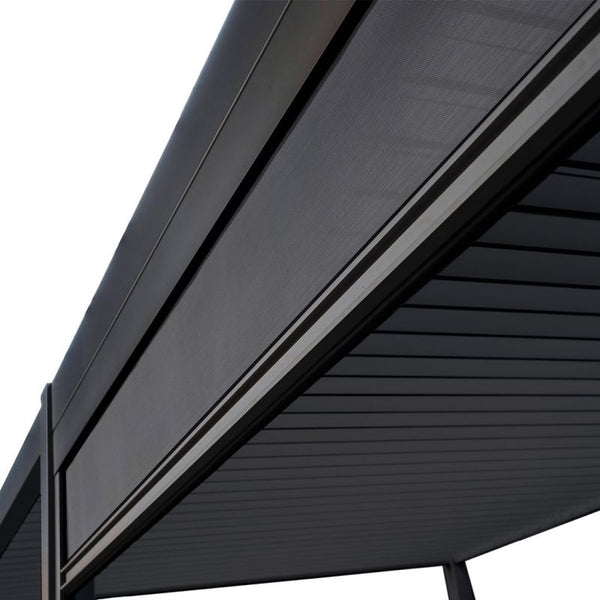
Aluminum allows slim, clean lines and a wide color selection through powder coating. Steel looks more massive and industrial – which can be intentional but doesn’t suit every garden. Wood radiates warmth and naturalness but changes visually over the years.
Price
In terms of raw material cost, wood is often the cheapest, steel is mid-range, and high-quality aluminum is somewhat higher. However, over the entire lifespan, the picture often reverses: aluminum requires hardly any maintenance or repair costs, making it more cost-effective in the long run. An honest overview of investment and models can be found on our Pergola price page.
Suitability for motorized louvered roofs
A motorized louvered roof has special requirements: the movable louvers must operate precisely, must not warp, and should be lightweight so the motor works efficiently. Aluminum is ideal for this – lightweight, dimensionally stable, and rust-free. Heavier materials put more strain on the mechanics and drive. That’s why practically all high-quality pavilions with louvered roofs use aluminum.
Our recommendation: Powder-coated aluminum from Sky Pergola
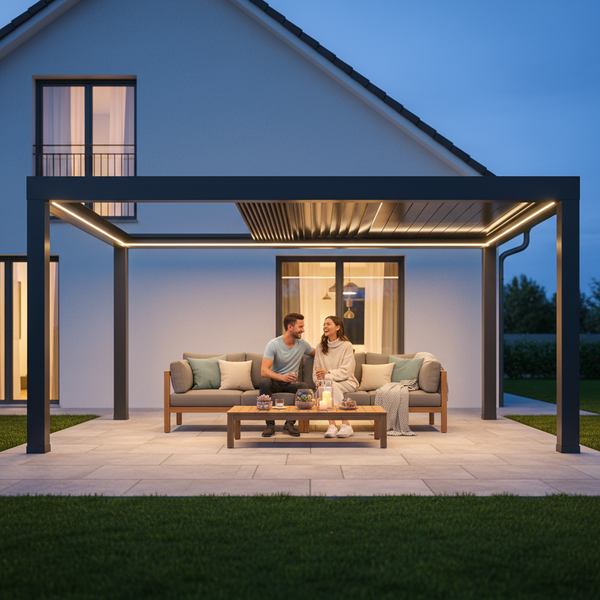
As a Swiss manufacturer, we produce our pergolas from weatherproof, powder-coated aluminum – rust-free, low-maintenance, and durable. We offer up to 10 years warranty on our louver roofs, and we deliver to Germany, Austria, and Switzerland.
There is a suitable model for every budget and requirement:
- SkyLite ECO – the solid entry-level model, from approx. €4,440. More on the SkyLite ECO product page.
- SkyMotion LED – motorized with integrated LED lighting, from approx. €5,410.
- SkyInfinity Pro – generous premium variant, from approx. €8,230.
- SkyMax Ultra – the top model for the highest demands, from approx. €9,100. Details about the SkyMax Ultra Pergola can be found here.
You can see a complete selection of all models in our Pergola Collection.
Frequently Asked Questions
Is a pergola made of aluminum or steel better?
For most terraces, aluminum is the better choice because it is rust-free, lightweight, and nearly maintenance-free. Steel offers higher maximum load capacity and is suitable for very large spans or industrial applications but requires regular care against rust.
Does an aluminum pergola rust?
No. Aluminum forms a natural oxide layer and does not rust. Combined with a powder coating, the surface is additionally protected against UV radiation, rain, and dirt, remaining weatherproof for many years.
How much maintenance does an aluminum pergola require?
Very little. Usually, occasional wiping with water is sufficient. No painting, rust protection, or further treatment is necessary, unlike with steel or wood.
Which material is suitable for a motorized louver roof?
Aluminum is best suited for motorized louver roofs. It is lightweight and dimensionally stable, so the movable louvers run precisely and the motor works efficiently without being burdened by heavy weight.
Is aluminum more expensive than steel?
In pure material costs, aluminum can be somewhat more expensive than steel. However, over the entire lifespan, it is often cheaper because there are hardly any maintenance or repair costs.
Not sure which model fits your terrace? Browse our Pergola Collection or simply call us – we are happy to advise you personally at +49 761 87003550.


