
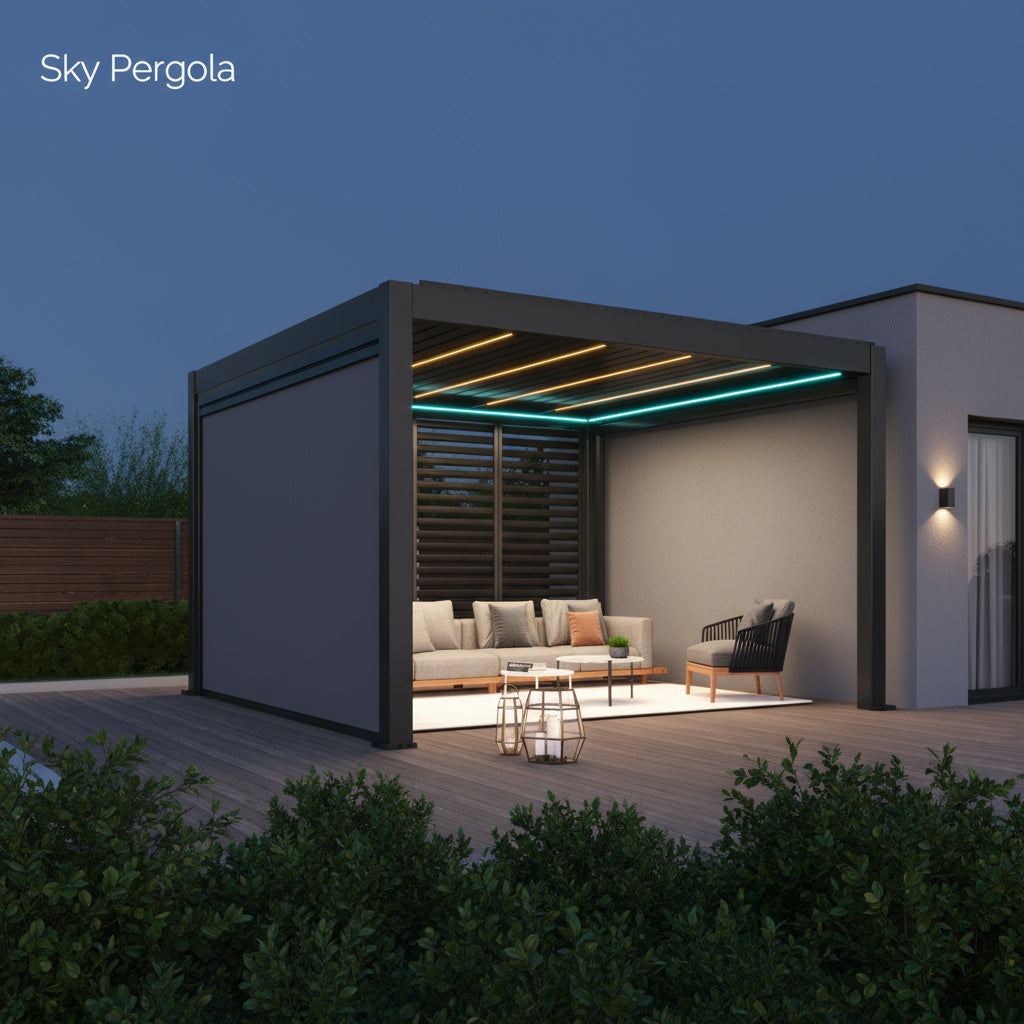
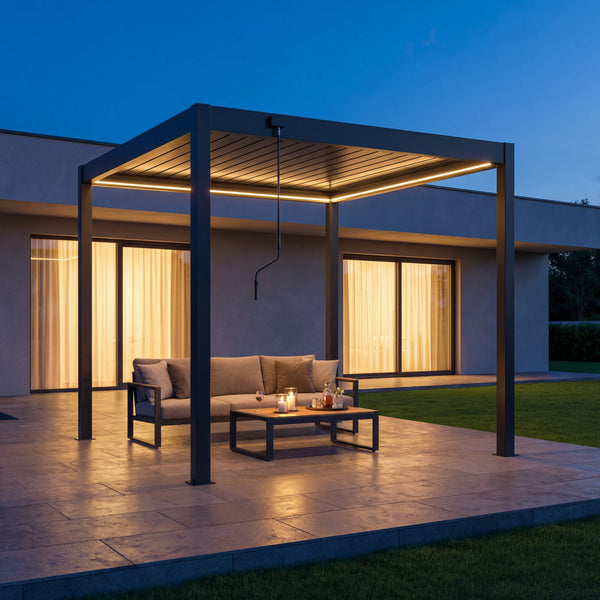
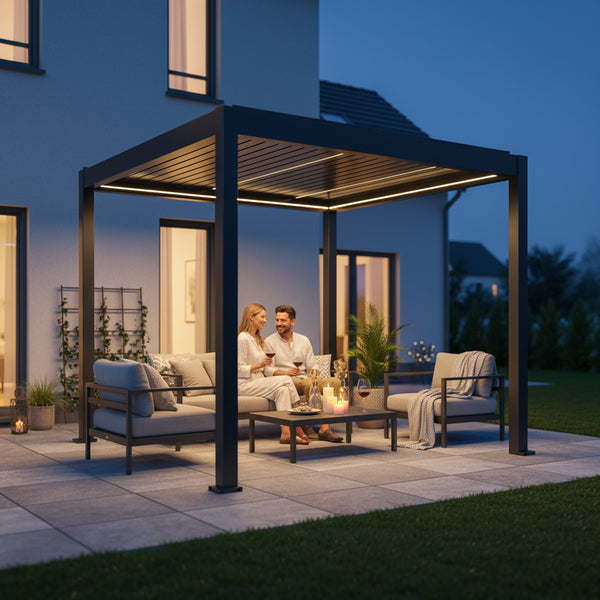
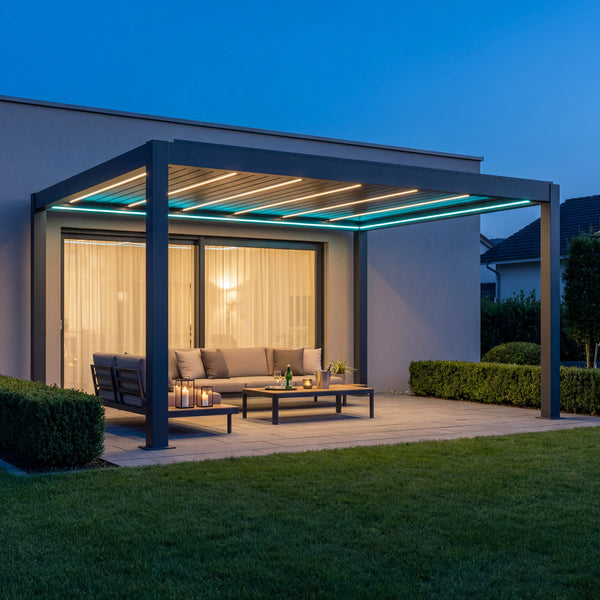




An eco pergola only deserves the name if the structure and the planting around it both survive a Dubai summer, and that is a harder brief than the brochure photographs suggest. The louvre roof is the straightforward half: powder-coated aluminium handles heat, UV and salt-laden air well, provided it is washed on the interval your location calls for. The planting is the half that is easy to get wrong, because species lists written for European and American gardens quietly assume rainfall, soft water and mild summers.
This guide treats the two as one system. You will see which of three zones a plant belongs in, why bougainvillea works in the sun zones and never under the roof, which popular temperate climbers to skip, why a vine should never be led onto the posts or the blades, where to stand planters relative to the roof's drip edges, and how to water so that the irrigation does not end up as residue on the coating.
It is also honest about what greenery does and does not do in this climate — that single admission shapes every recommendation below. Shade is the roof's work. The planting changes the soil, the ground surface, the glare and the feel of the space. Both matter, but they are not interchangeable, and knowing which does which stops you buying the wrong plant for the wrong job.
Key takeaways
- The roof delivers the shade; planting mainly relieves glare, ground heat and reflected radiation. In hot-arid research from Las Vegas, street trees cut mean radiant temperature by up to 8 °C in the baseline scenario and up to 16 °C under maximum planting, while daytime air-temperature cooling was close to nil and the measured effect was largely nocturnal, at 0.25 to 1.3 °C [1].
- Keep climbers off the structure. Vines with holdfasts cling directly to surfaces and can damage them unless they are trained to a separate trellis, and large-maturing vines load their support heavily [2].
- Bougainvillea belongs in the sunny zones only — on its own frame beside the pergola, reaching over the roof, never underneath it. It needs full sun to produce coloured bracts and resists blooming if it gets too much shade and water [3]. It reaches roughly 4.5 to 12 m, grows rapidly and has to be tied on rather than left to self-attach [4].
- Drip, not spray. FAO's indicative field application efficiency is 90 % for drip against 75 % for sprinkler irrigation [5], and overhead water carrying over about 3 me/l (milliequivalents per litre) of sodium or chloride scorches foliage [6].
- Wash the coating with clean water or a pH-neutral mild detergent, yearly in normal urban use and at least every three months in coastal exposure [7]. Descalers and alkaline cleaners sit outside the pH 4 to 9 band in which aluminium stays passive [8].
- Plant now, not in spring: Dubai's winter average high of 23 °C against a summer average high of 41.8 °C is what makes the cool months the working window [9].
What an eco pergola can and cannot do
Marketing tends to merge two different claims into one green promise. Separating them is the most useful thing you can do before you buy a single plant.
What the roof does
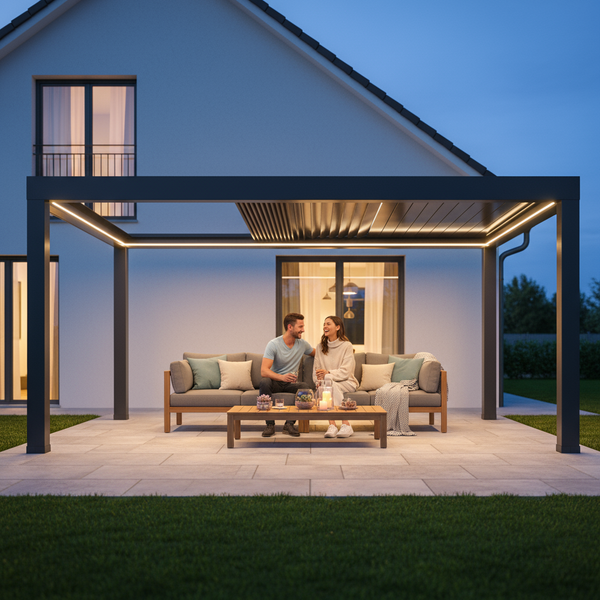
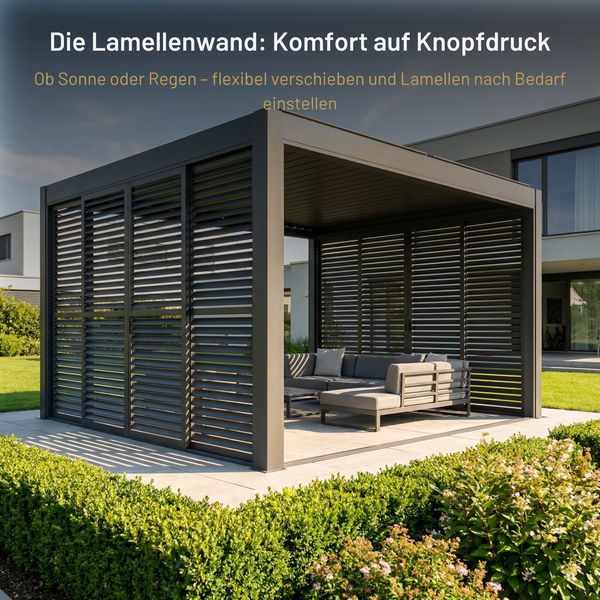
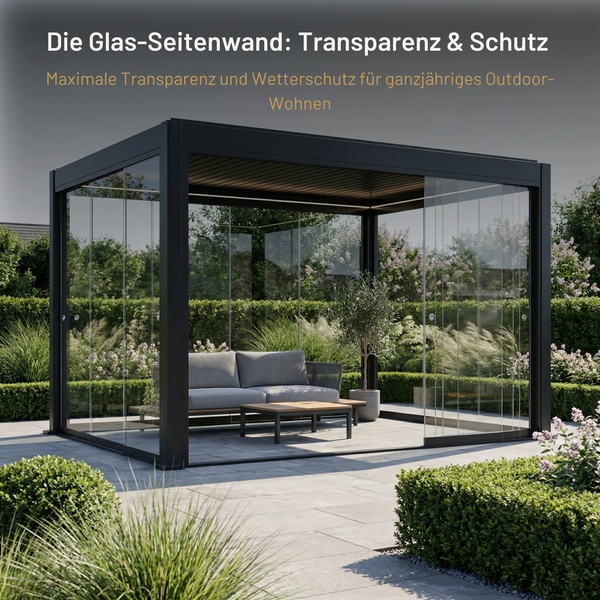
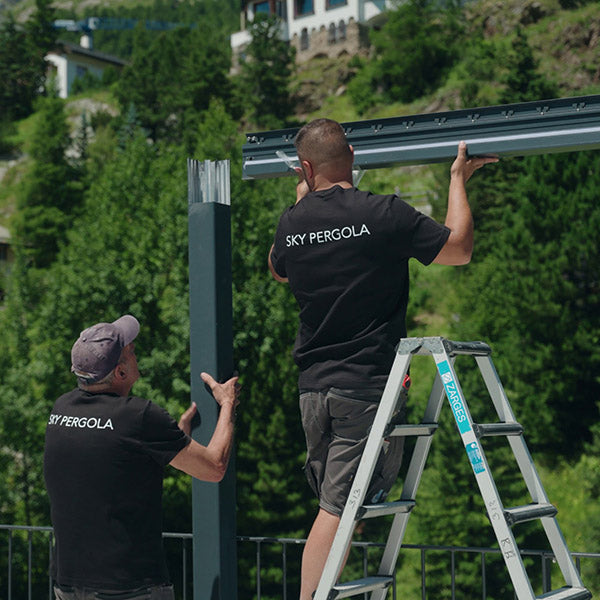
A louvre roof intercepts solar radiation before it reaches the terrace, the furniture and you. Closed, the blades overlap to block direct sun and shed rain into gutters inside the beams and down through the posts — rainproof, with the honest caveat that in extreme storms the construction can let occasional water through. Partly open, they let the hot air that collects underneath escape upward instead of sitting on the seating area. That combination — interception plus ventilation — is something no plant on a 3 by 3 m terrace can replicate, and it is available on demand rather than only once the planting has matured. If you want the mechanics in detail, the louvre roof pergola in Dubai: motorised bioclimatic aluminium roofs page walks through the rotation range and drainage path.
What the planting does
Planting works on the surfaces and the air at ground level. It covers hot paving, shades the soil, breaks up reflected light and softens the hard edges of an aluminium frame. The hot-arid evidence is clear that the dominant mechanism is interception of solar radiation rather than transpiration: in the Las Vegas study, the air-temperature benefit of street trees appeared mainly at night, at 0.25 to 1.3 °C, with little daytime effect, while mean radiant temperature — what your skin actually registers — dropped by up to 8 °C [1]. That is Las Vegas data rather than a UAE measurement.
The division of labour
So the realistic claim is this: the roof makes the space usable, the planting makes it comfortable and pleasant at eye level and below. Design guidance in Trakhees jurisdiction areas points in the same direction — sites are required to contribute to the relief of heat, noise, dust and glare through proper placement of green planting, and to provide a natural shading device [10]. Note the scope: that wording belongs to the Trakhees and Ports, Customs and Free Zone Corporation design guidelines and does not automatically apply to every Dubai community. Ask your master developer or community management which rules govern your plot.
Dubai's growing conditions in numbers
Every planting decision below follows from four climate and water realities.
Heat that does not switch off at night
Dubai's summer average high is around 41.8 °C with overnight lows around 29.7 °C, while winter brings an average high of 23 °C and overnight lows of 14 °C [9]. The overnight figure is the one gardeners underestimate. A plant in a container has no deep soil to buffer it, so it spends the summer night at close to 30 °C with no recovery period. That is why pot size, pot position and mulch matter more here than species labels promising heat tolerance.
Almost no rain, and high humidity in winter
The city receives an average of 87.3 mm of rain per year, and relative humidity averages 59 % annually, peaking at 65 % in January and February [11]. Practically: all your water is irrigation water, and the humid winter peak is the period when foliage stays wet longest after watering. It is also the period when the roof's drainage gets tested, so it is the natural time to check that nothing organic has collected in the gutters.
Water that may carry a salt load
Salt load is the risk that is easiest to miss in container planting. The Environment Agency – Abu Dhabi reports that 79 % of the emirate's groundwater reserves have become highly saline, 18 % are brackish and only 3 % can be considered fresh, with over 100,000 wells counted and documented [12]. That is why well water is the wrong default. FAO's thresholds give you a yardstick: irrigation water below 0.7 dS/m carries no restriction on use, 0.7 to 3.0 dS/m is a slight to moderate restriction, and above 3.0 dS/m is a severe restriction [13].
Free-draining substrate — what that means for a pot
Sandy substrate drains fast and holds little; that is practical experience on terraces here rather than a sourced figure. For pergola planting it is partly an advantage — you can leach salts out of a pot easily — and partly a trap, because fertiliser and minerals move straight through and end up wherever the pot drains, which is often onto the terrace surface or against a post base plate.
Where these figures come from
Some of the research behind this guide was not carried out in the UAE, and it is fairer to say so once than to hedge every sentence. The bougainvillea care sheet from Clemson Cooperative Extension dates from 2015 and describes South Carolina conditions, so read its seasons as our cool months [14]. The bougainvillea salt-tolerance trial ran under controlled conditions in China and compares varieties rather than gardens [15]. The groundwater shares above describe Abu Dhabi emirate, not Dubai [12]. The vine-attachment guidance is US extension material, although attachment mechanics are a property of the species rather than the place [2], and the irrigation loss ranges come from Utah State University Extension [16]. Two transfers are genuinely contestable and are flagged where they appear: the Las Vegas street-tree study and the Phoenix mulch trial.
Three planting zones around a louvre roof
The single biggest mistake in the generic plant lists is treating a pergola as one location. It is three, and they have almost nothing in common.
| Zone | Light reality | What suits it | Main risk to the structure |
|---|---|---|---|
| The airspace over the roof | Full sun above the blades; the roof shades downward, not the plant | Sun-demanding flowering climbers, grown on their own frame beside the pergola and allowed to reach over | Litter and stems dropping into the gutters, foliage blocking the blades |
| Beside the pergola, in sun | Full sun for most of the day, with shade moving across in the afternoon | Climbers on a free-standing trellis, large shrubs, grasses, container specimens | Weight carried by the trellis footing, which has to be its own; irrigation overspray and fertiliser splash reaching posts and blades |
| Underneath the roof | Bright indirect light when the louvres are open, deep shade when closed | Shade-tolerant foliage only; nothing that needs full sun to flower | Standing water at post feet, residue rings on the terrace, pots blocking cleaning access |
The third row is deliberately short on names. The sourced species guidance available to us covers sun-loving bougainvillea, not shade foliage, so instead of guessing we give you the selection criteria and a nursery that has actually grown plants in this climate can match them.
What to ask a nursery before you buy
These are the questions the zone model generates. Take them with you, for every species on your list and not only for climbers.
- Does this plant need full sun to flower, or will it keep its character in shade? That one answer assigns it to a zone. Bougainvillea is the worked example: highly drought tolerant, but it must be in full sun to produce numerous coloured bracts and resists blooming if it receives too much shade and/or water [3].
- How dry does it want to be? Over-watering a drought-tolerant plant with a misdirected or overactive sprinkler is a named mistake, and keeping bougainvillea on the dry side serves both blooms and healthy roots [17]. A plant that wants constant moisture is a poor neighbour for one that does not, on the same drip line.
- Which variety is it, and how salt-tolerant is that variety? In a 2024 trial, bougainvillea varieties were tested at 0.0 %, 0.2 %, 0.4 % and 0.6 % sodium chloride, tolerance differed markedly between varieties, and the authors report that bougainvillea cannot grow normally under 0.8 % and 1.0 % treatments [15]. Pair that question with the conductivity of the water you will actually use [13].
- What is the mature size, not the size on the trolley? Bougainvillea spectabilis reaches roughly 4.5 to 12 m in height and 4.5 to 12.5 m in width at a rapid growth rate [4]. That decides how far from the roof edge the trellis goes.
- How does it attach? Vines with holdfasts cling directly to surfaces and can damage them unless they are trained to a separate trellis [2]. Bougainvillea climbs by curved thorns and quasi-twining stems rather than tendrils and is best tied to a structure for support [4] — a plant you tie on is a plant you can take off again.
- Does it have thorns, and where will people walk? NC State Extension warns that the thorny plant should be kept away from high-traffic areas because the thorns can be painful [18]. On a terrace where people pass between the posts and the furniture, that rules out the entry side.
- How much does it drop, and when? Spent flowers, seed heads and leaf fall are a drainage question on a louvre roof, not a sweeping question.
Bougainvillea: the sun zones only
Bougainvillea is an obvious pergola choice, and a reasonable one — in the sunny zones only: on its own frame beside the pergola, reaching over the roof, never underneath it. Clemson Cooperative Extension states that bougainvilleas are extremely drought-resistant and thrive in almost any soil type, and that they should be grown outdoors in full sun with no shade, with severe pruning carried out after summer flowering [14]. UF/IFAS Extension puts the light requirement more bluntly: the plant is highly drought tolerant but must be in full sun to produce numerous coloured bracts, and it resists blooming if it receives too much shade and/or water [3]. A bougainvillea placed under the louvres will produce foliage and sulk. The same plant beside the pergola, climbing its own frame into open sky above the roof, performs.
The temperate list to skip
English ivy, Virginia creeper, honeysuckle, wisteria and climbing roses turn up in pergola plant guides aimed at Dubai readers. They are temperate-climate plants, and whatever the species, the general rule from extension guidance decides where they may go: vines with holdfasts cling directly to surfaces and can damage them unless they are trained to a separate trellis, and large-maturing vines put a lot of weight onto their support [2]. A structure you have to clean, inspect and service is the wrong host for anything that attaches itself. Indoor foliage plants such as pothos or ZZ plant are a separate category again: they can work in a shaded container under the roof, but they are not a substitute for a sun-tolerant garden plant.
Why climbers should never be led onto posts, louvres or drainage channels
This is the section no plant-centred article writes, and it is the one that decides whether your roof still works in five years.
The drainage path is inside the structure
On a bioclimatic roof the water does not run off the edge onto the lawn. It collects in gutters built into the beams and drains down through the posts. The SkyLite ECO description puts it plainly: an innovative drainage system through the posts, louvres and gutters ensures standing water is effectively drained, which reduces wear. That means leaf litter, spent flowers, seed heads and wandering stems are not a cosmetic issue — they are a blockage in a closed channel you cannot see into from the terrace. A climber trained over the beams feeds material directly into that path, continuously, for as long as it lives. Treat gutter checks as a practical maintenance habit rather than an occasional afterthought.
Weight and movement
Large-maturing vines put a lot of weight onto their support structure [2]. A rotating louvre roof is not a static trellis: the blades turn in unison on a linkage, and on motorised models the motor sits hidden inside the beam. Anything wound around a blade, a linkage arm or a post is a load the mechanism was never asked to carry, and stems thicken over years. A vine does not need to break anything to cause a problem; it only needs to stop the blades closing fully.
Cleaning and service access
Once a climber covers the frame, you lose the ability to wash the coating, inspect fixings or clear the gutters without cutting the plant back hard every time. That is the practical argument against the postcard look: the maintenance you are then skipping is exactly the maintenance that keeps the finish and the mechanism in good order.
The free-standing trellis solution
Build the climber its own support next to the pergola and let it reach over without touching it. As a working rule of thumb we suggest:
- Set the trellis so that mature foliage stays clear of the roof edge — for a vigorous climber, allow for the width figures above rather than the size at purchase [4].
- Leave an arm's width of clear floor between trellis and posts so you can still reach every post and the roof perimeter with a cloth and a hose.
- Fix the trellis into its own footing rather than into the pergola posts, so the plant's weight stays on its own structure [2], and ask us before attaching anything to the pergola — the anchoring is specified for the roof you ordered.
- Tie the stems in deliberately, rather than relying on self-attachment. For bougainvillea that is the recommended method anyway [4].
- Prune to a silhouette that stops at the roof line, so overhang gives you shade on the trellis side without dropping litter into the gutters.
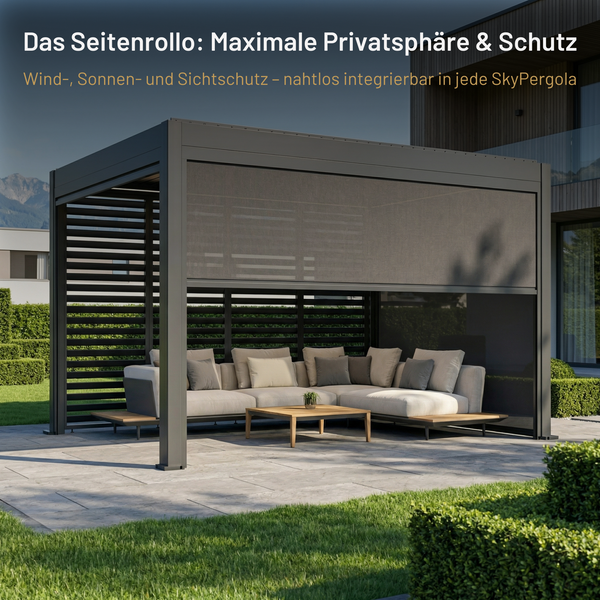
If the real goal is a green screen for privacy or wind, compare that with the engineered options first: a Sky Pergola Side Blind from AED 5,175 does the screening job immediately, needs no water and does not grow into the mechanism. You can also use both — the blind on the exposed side, the planting where it is decorative.
Placing the planters: drip edges, post feet and root-zone heat
Read the drip line before you place a pot
Even with internal drainage, a louvre roof has edges where water leaves the structure, and the posts have base plates where water collects if the terrace does not fall away. Watch the terrace during the first winter downpour and mark where water actually runs — those are the places not to stand a planter. Rain is scarce, at an average of 87.3 mm per year [11], but it arrives concentrated, and a pot sitting in a puddle for a day combines the two things container roots hate most: no oxygen and dissolved salts going nowhere.
Keep pots off the post feet
Powder-coated aluminium does not rust, but the coating is the protective layer and aluminium itself is only nominally passive between about pH 4 and pH 9, where its oxide film protects it; outside that band the film becomes soluble and the metal dissolves relatively rapidly, in the alkaline range as aluminate [8]. A pot pressed against a base plate traps permanently damp substrate, fertiliser salts and grit against the coating and removes your ability to see what is happening there. Stand planters clear of the posts, on feet, so that water drains away and air moves underneath.
Root-zone heat is your real species filter
With overnight lows around 29.7 °C in summer [9], a container on an exposed terrace is the hottest root environment in the garden. Three levers help: volume, position and surface. Bigger pots buffer temperature swings; a pot placed where the roof's closed-louvre shadow falls during the afternoon stays kinder than one in open sun; and a surface cover changes the soil itself. On the last point there is measured evidence from a desert-landscape trial in Phoenix: soil under decomposed-granite mulch or with no mulch at all was roughly 8 to 10 °C warmer at 30 cm depth than soil under organic mulches, and daytime soil temperatures at both 5 and 30 cm were consistently lower beneath the organic mulches [19]. Phoenix, not Dubai — but it is the clearest argument for choosing an organic mulch over a decorative gravel top-dressing in beds and large containers.
Do not fill the shaded floor
Pots under the roof are tempting and they are where guests walk. Leave the circulation route and the post surrounds clear, and group containers in the corners where the louvres cast the deepest shade. You will water less and you will still be able to clean.
Irrigation, water quality and keeping the coating clean
Drip, not spray — twice over
Drip irrigation wins on both counts that matter here. FAO's indicative values put the field application efficiency of drip irrigation at 90 %, against 75 % for sprinkler irrigation and 60 % for surface irrigation [5], and Utah State University Extension puts evaporation and wind-drift losses of spray and sprinkler devices at 15 % to 40 % depending on the device type, while crediting drip systems with 90 % or more [16]. Those are figures from two different systems and should be read side by side, not added together. The second count is the pergola itself: every droplet that drifts is a droplet landing on blades, beams and furniture, carrying whatever minerals and fertiliser it picked up.
Why overhead watering burns leaves here
There is a plant-health reason too. FAO describes foliar damage from overhead sprinkling when the water contains over roughly 3 me/l of sodium or chloride — milliequivalents per litre, a figure your water report or a lab test will give you: the salts concentrate on the wet leaf as water evaporates between sprinkler rotations and are then absorbed in excessive amounts through the leaf [6]. FAO also notes that shifting irrigation to periods of higher humidity, such as at night, has often greatly reduced or eliminated the problem [20]. If you have inherited a spray system you cannot change immediately, moving the schedule to the late evening is the single cheapest improvement available. Converting to drip is better.
Match the water source to the planting
| Water source | What to establish before you rely on it | Sensible use | What tends to show up on the aluminium |
|---|---|---|---|
| Desalinated mains supply | Have the electrical conductivity confirmed and read it against the FAO classes: no restriction below 0.7 dS/m [13] | Containers and sensitive species; the default for planting close to the structure | Little from the water itself; marks usually come from dust and fertiliser |
| Treated sewage effluent (TSE) | Which quality grade is supplied; in Trakhees jurisdiction areas landscaped areas must have a permanent irrigation system fed by high-quality, human-contact-standard treated sewerage effluent or reverse-osmosis water, protected by a back-flow system [21] | Lawn, beds and robust shrubs away from the pergola footprint | Mineral and organic residue wherever droplets dry; keep emitters low and away from posts |
| Well or groundwater | Conductivity, every time. Regionally, 79 % of Abu Dhabi's groundwater reserves are highly saline, 18 % brackish and only 3 % fresh [12] | Only after testing; above 3.0 dS/m FAO classes it as a severe restriction on use [13] | The heaviest residue of the three; never spray it near a coated surface |
Leaching, not guessing
In sandy substrate watered with a salt-carrying supply, salts build up in the pot rather than being rained out of it — that is practical experience here, not a sourced figure. Periodically water a container until a generous volume runs out of the base, so the accumulated salts move through and out instead of concentrating. Make sure that runoff has somewhere to go that is not a post base plate or a terrace joint. For bougainvillea specifically, bear in mind that UF/IFAS Extension names over-watering this drought-tolerant plant with a misdirected or overactive sprinkler as a mistake and advises keeping it on the dry side for both blooms and healthy roots [17] — a deliberate occasional flush is not the same thing as a constantly wet pot.
Residue and fertiliser on powder coating
Three things mark a coated louvre: airborne dust, dried irrigation droplets and fertiliser splash. The fix is procedural rather than chemical. Granular feed goes into the pot, below the mulch, not scattered across the surface next to a post. Liquid feed is applied through the drip line or by can at soil level, not sprayed. Anything that does land gets rinsed the same day, before it dries and bakes.
Cleaning off what the planting leaves behind
For those plant-specific marks, clean water and a soft cloth are usually enough; where they have dried on, QUALICOAT UK and Ireland recommends clean water or a pH-neutral mild detergent solution in water for architectural powder coating, washed down at yearly intervals in normal urban use and at least every three months in coastal locations [7]. Avoid descalers, bleach and alkaline cleaners entirely: aluminium is only nominally passive between about pH 4 and pH 9, and outside that band the protective film becomes soluble [8]. A coating chip plus an aggressive cleaner is how a cosmetic mark becomes a durability problem. Water, a soft cloth, patience.
Heat and glare: where green cools and where only the roof helps
The glare nobody plans for
If your terrace is finished in light travertine or pale porcelain, that choice has a thermal consequence that goes the wrong way. A 2026 review of outdoor thermal comfort interventions in Middle East and North Africa cities finds that high-albedo paving and reflective surface treatments lower surface temperatures but can raise mean radiant temperature through reflected radiation unless they are combined with shading elements [22]. In other words, a bright floor keeps itself cooler by sending radiation back up at you. This is precisely where planting earns its place: ground cover, low planting along the terrace edge and containers positioned on the bright side interrupt that upward reflection, and in Trakhees jurisdiction areas the design guidelines name glare relief as an explicit function of properly placed green planting [10].
What the roof alone can do
Closed, the blades give you deep shade and block direct radiation. Partly open, you trade some shade for ventilation and let hot air leave upward. Through a Dubai day the useful pattern is: open in the early morning for light and breeze, closed through the midday peak, part-open from late afternoon as the air temperature falls, and open in the evening. The bioclimatic pergola Dubai guide on how rotating louvres beat the heat covers that rhythm in more depth.
What the planting adds, realistically
Do not expect the greenery to lower the air temperature on a 41.8 °C afternoon [9]; the hot-arid evidence says daytime air-temperature cooling from trees is slight and the benefit shows up mainly at night and in radiant terms [1]. Expect instead: a cooler soil surface under organic mulch [19], less reflected glare at eye level [22][10], and a space that reads as a garden room rather than a shaded slab. That is a real gain.
Where the two combine
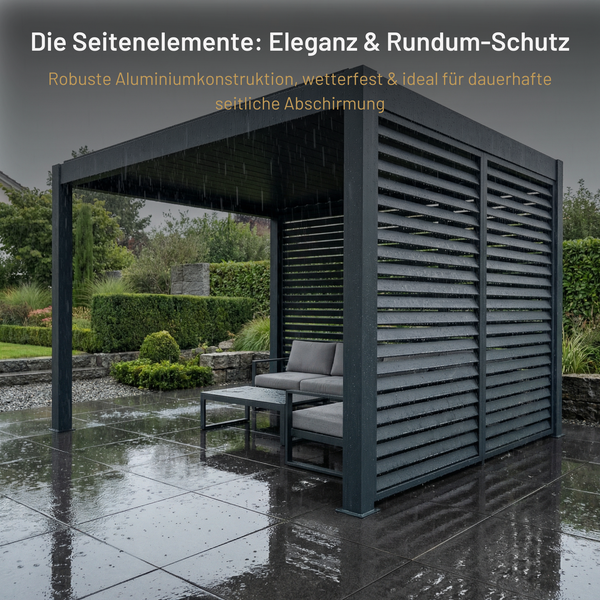
Planting on the sun-facing side, at the height where low afternoon sun comes in under the roof edge, is the one place where green does structural work the blades cannot. Low sun arrives horizontally; a roof cannot block it. A trellis with a dense climber there is one answer. The other is a fixed louvre wall: the Sky Pergola Side Element from AED 8,505 closes that side immediately, and the two work well together — planting where it is decorative, the element where the sun actually comes in.
Planting and maintenance calendar for the season starting now
The window that matters opens with the cool season, and the reason is simply the temperature gap: a winter average high of 23 °C against a summer average high of 41.8 °C [9]. Late October is the start of it, not the end.
Late October to November — the planting block
- Set the planting plan by zone first: over the roof, beside, underneath. Place nothing before you have walked the terrace and marked the drip edges and post feet.
- Plant now, while root systems can establish in soil that is not at summer temperature.
- Install or convert to drip lines, with emitters at the plant, not aimed anywhere near posts or blades [5][16].
- Build the free-standing trellis on its own footing and tie in the first growth [2][4].
- Apply organic mulch to beds and large containers rather than decorative gravel [19].
December to January — establishment and the wet test
- Water to establish, early or late in the day rather than in the middle. If any overhead watering remains in the system, run it in the humid hours [20].
- Humidity peaks at 65 % in January and February [11]: foliage stays wet longer, so keep water off leaves and watch for fungal issues.
- After the first real rain, check that the roof gutters and post outlets are running clear and clear anything organic by hand.
Late January to early March — pruning and the second window
- Clemson Cooperative Extension places severe pruning of bougainvillea after summer flowering, in late autumn or very early spring [14] — read that as our cool months. Cut back anything reaching toward the roof line now, while you can see the structure.
- Use the second planting window for gap-filling and replacements.
- Leach containers thoroughly, checking that runoff drains away from the structure [13].
March to May — get ready for the heat
- Wash the frame before summer: clean water or a pH-neutral mild detergent, and at least every three months if you are in coastal exposure [7].
- Increase drip run times gradually rather than adding emitters.
- Top up mulch so the soil surface is covered before peak radiation [19].
- Last structural prune: nothing should be within reach of the blades by May.
June to September — hold the line
- No planting. Maintain only.
- Shift irrigation to the cooler, more humid hours [20].
- Rinse dust and any fertiliser splash off the louvres rather than letting it bake on.
- Keep pots out of standing water and out of contact with the posts [8].
Which Sky Pergola model suits a planted garden
Planting changes which roof makes sense, mostly through access, span and litter management.
SkyLite ECO — the straightforward planted terrace
The SkyPergola SkyLite ECO aluminium pergola is 3 by 3 m with a manual louvred roof, integrated LED lighting and drainage routed through the posts, louvres and gutters; it is powder-coated, rainproof and withstands wind up to 120 km/h, from AED 21,555. For a seating nook with containers underneath and a trellis alongside, the manual roof is genuinely adequate: you set the blades for the time of day and leave them. Bear in mind that rainproof is not a promise of a sealed box — in extreme storms the construction can let occasional water through — which is another reason to keep sensitive containers off the drip lines.
SkyMotion LED — when you adjust the blades daily
Planting under the roof makes the blade position a daily decision, because the light your shade containers receive is whatever you leave them. The SkyPergola SkyMotion LED aluminium pergola, also 3 by 3 m with a motorised louvred roof, integrated LED and the same post-and-gutter drainage, rated to 120 km/h, from AED 28,755, makes that adjustment effortless. The motor sits hidden inside the beam, and posts, beams and louvres share the same colour — worth choosing against your planting and paving rather than in isolation.
Larger spans and clear floor
If the planting plan needs an uninterrupted floor — a long trellis run, big specimen containers, a dining zone that is not broken by posts — look at the SkyPergola SkyMax Ultra aluminium pergola at 4 by 6 m with illuminated louvres and motorised operation, or the SkyPergola SkyGrand Master aluminium pergola at 5 by 5 m, which is built entirely without obstructive central posts. Fewer posts means fewer base plates to keep clear of pots, and a longer clear edge for low planting.
Accessories that work with planting rather than against it
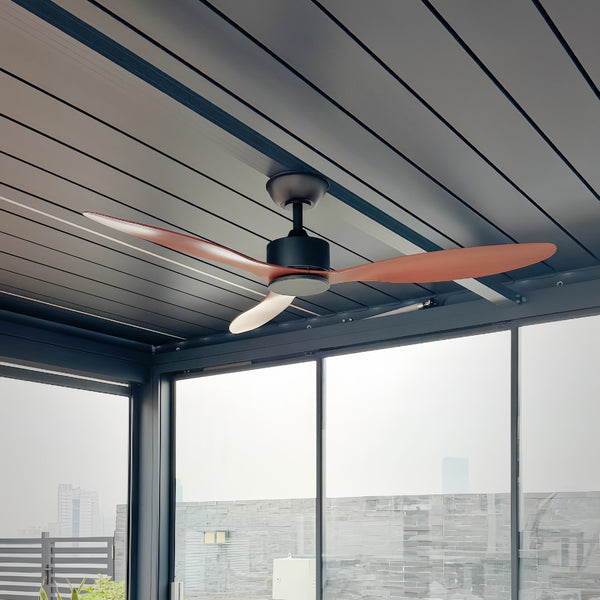
Two are worth naming. A Sky Pergola Fan from AED 6,705 moves air across the seating area, which is the comfort lever planting cannot pull in daytime. And where you want a screen immediately rather than in three growing seasons, the Side Blind or the Side Element mentioned earlier does it without adding anything to the drainage path. For colour and finish comparisons across the range, the pergola models overview is the quickest way to see the options side by side.
The bottom line for a planted eco pergola
Build the roof as the shading system and the planting as everything that happens at and below eye level, and keep them physically separate. Train climbers onto their own trellis beside the structure, never onto posts, blades or the drainage channels [2]. Put sun-demanding plants in the sun — bougainvillea beside the pergola and over the roof, not under it, because under a louvre roof it will not flower [3]. Water by drip rather than spray, both for efficiency and to keep salt-bearing droplets off leaves and coating [5][6]. Stand pots clear of the post feet and the drip edges, mulch organically, and wash the frame on the interval your location deserves — yearly inland, at least quarterly near the sea [7].
Do that and the result is genuinely better than either half alone: adjustable shade when the sun is overhead, a cooler and less glary floor from the planting, and a structure you can still clean and service in year ten. If you want to work out which model and size fits your terrace and your planting plan, start in the Sky Pergola configurator, or ask us about your specific layout before you order the plants — moving a trellis on paper is cheaper than moving it in the ground.
Frequently asked questions
Can I grow climbing plants on an aluminium pergola, or will the vine damage it?
Grow them beside it, not on it. Vines with holdfasts cling directly to surfaces and can damage them unless trained to a separate trellis, and large-maturing vines put a lot of weight onto their support[2]. On a louvre roof there is a second problem: water drains through gutters in the beams and down the posts, so stems, leaves and seed heads end up in a channel you cannot inspect. A free-standing trellis on its own footing keeps the mechanism and the drainage clear, and ask us before you attach anything to the structure itself.
Which climbing plants actually survive a Dubai summer on a pergola?
Plants that take full sun and dry roots, not the temperate list you often see. Bougainvillea is the one we can point to with sourced guidance: it is extremely drought-resistant and thrives in almost any soil type, but it must be in full sun with no shade[14]. English ivy, Virginia creeper, honeysuckle, wisteria and climbing roses are temperate plants, and the rule for anything that clings directly to a surface is the same in every case — it belongs on a separate trellis, not on a structure you have to clean and service[2]. Beyond that, ask your nursery the selection questions in the article: light requirement, how dry it wants to be, variety-level salt tolerance, mature size, how it attaches, thorns and how much litter it drops.
Why does my bougainvillea grow lots of leaves but no flowers under the pergola?
Because it is in the shade zone, and bougainvillea belongs in the sunny ones. It is highly drought tolerant but must be grown in full sun to produce numerous coloured bracts, and it resists blooming if it receives too much shade and/or water[3]. Under a louvre roof it gets neither full sun nor dry roots. Move it beside the pergola onto its own trellis in open sky, where it can reach over the roof rather than sit beneath it, cut back the watering, and keep it on the dry side for both blooms and healthy roots[17].
Drip irrigation or sprinklers for a pergola planting in Dubai?
Drip, for two separate reasons. FAO's indicative field application efficiency is 90 % for drip against 75 % for sprinkler irrigation[5], and spray devices lose 15 % to 40 % to evaporation and wind drift depending on type[16]. Second, overhead water carrying over about 3 me/l of sodium or chloride — milliequivalents per litre, a figure a water report or lab test will give you — scorches foliage as droplets concentrate on the leaf[6]. Drift also lands minerals and fertiliser on the louvres. If you cannot convert immediately, water at night[20].
What are the white marks on my louvres, and can I use a descaler to remove them?
They are usually dried irrigation residue, fertiliser splash or dust, and no, do not reach for a descaler. Aluminium is only nominally passive between about pH 4 and pH 9, where its oxide film protects it; outside that band the film becomes soluble and the metal dissolves relatively rapidly[8]. Use clean water or a pH-neutral mild detergent solution, as recommended for architectural powder coating[7], with a soft cloth. Rinse fresh splashes the same day, before they bake on.
Will leaves and seeds from my planting clog the pergola gutters?
They can, and that is why plant placement matters more than plant choice. A bioclimatic roof carries water in gutters inside the beams and down through the posts, so organic debris does not simply blow off an open edge. Prune your climber so its silhouette stops at the roof line, keep litter-heavy species away from the perimeter, and check the gutters and post outlets by hand after the first rain of the season — annual rainfall averages 87.3 mm and arrives concentrated[11].
When is the planting season in Dubai, and is late October too late?
Late October is the start, not the end. The cool-season window exists because Dubai's winter average high is 23 °C with overnight lows of 14 °C, against a summer average high of 41.8 °C and overnight lows of 29.7 °C[9]. Planting now gives roots months to establish before heat returns. Use late October and November as the main block, keep February and March for gap-filling, and treat June to September as maintenance only.
Do I need a permit for a pergola in a Dubai villa community?
Treat that as a question for the authority with jurisdiction over your plot rather than something to settle from a blog. Requirements differ by community and by authority, and we do not promise that any structure is exempt. Ask your master developer or community management which approvals and no-objection certificates apply, and get the answer in writing from them before you order. Some jurisdictions also set landscape and irrigation requirements — Trakhees areas, for example, require a permanent irrigation system fed by high-quality treated sewerage effluent or reverse-osmosis water with back-flow protection[21].
Sources
- Effectiveness of street trees in reducing air temperature and outdoor heat exposure in Las Vegas (Henao et al., 2025) – Environmental Research: Climate (IOP Publishing)
- Vines for Maryland Gardens – University of Maryland Extension
- My bougainvillea was planted in the shade and I have had no blooms. What can I do? – UF/IFAS Extension Nassau County, University of Florida
- Bougainvillea spectabilis — Extension Gardener Plant Toolbox – NC State Extension (North Carolina State University and N.C. A&T State University)
- Annex I: Irrigation efficiencies (Irrigation Water Management: Introduction to Irrigation) – Food and Agriculture Organization of the United Nations (FAO)
- Water Quality for Agriculture (FAO Irrigation and Drainage Paper 29) – Food and Agriculture Organization of the United Nations (FAO)
- Maintaining the Architectural Powder Coating Colour – QUALICOAT UK and Ireland
- Durability and Corrosion of Aluminium and Its Alloys: Overview, Property Space, Techniques and Developments (Sukiman et al., 2012) – IntechOpen, in: Aluminium Alloys — New Trends in Fabrication and Applications
- Geographic Location and Climate – Dubai Government Media Office
- Building Regulation Design Guidelines — Architecture Book (Blue Code), 2021 edition – Trakhees, Ports Customs and Free Zone Corporation, Government of Dubai
- Geographic Location and Climate – Dubai Government Media Office
- The Environment Agency – Abu Dhabi reveals the most prominent challenges faced in Abu Dhabi (18 February 2021) – Environment Agency – Abu Dhabi (EAD)
- Water Quality for Agriculture (FAO Irrigation and Drainage Paper 29) – Food and Agriculture Organization of the United Nations (FAO)
- Bougainvillea — Home and Garden Information Center – Clemson University Cooperative Extension
- Physiological Responses and Salt Tolerance Evaluation of Different Varieties of Bougainvillea under Salt Stress (Zhang et al., 2024) – Plants (Basel), MDPI / US National Library of Medicine PMC
- Irrigation Water Loss and Recovery in Utah – Utah State University Extension
- Bougainvillea are daytime beacons of color (Ralph Mitchell, 1 December 2023) – UF/IFAS Extension Charlotte County, University of Florida
- Bougainvillea spectabilis — Extension Gardener Plant Toolbox – NC State Extension (North Carolina State University and N.C. A&T State University)
- Effect of Landscape Mulches on Desert Landscape Microclimates (Singer and Martin, 2008) – Arboriculture and Urban Forestry, International Society of Arboriculture
- Water Quality for Agriculture (FAO Irrigation and Drainage Paper 29) – Food and Agriculture Organization of the United Nations (FAO)
- Building Regulation Design Guidelines — Architecture Book (Blue Code), 2021 edition – Trakhees, Ports Customs and Free Zone Corporation, Government of Dubai
- Systematic review of outdoor thermal comfort interventions in MENA cities – Frontiers in Sustainable Cities
Last updated: October 2026


