
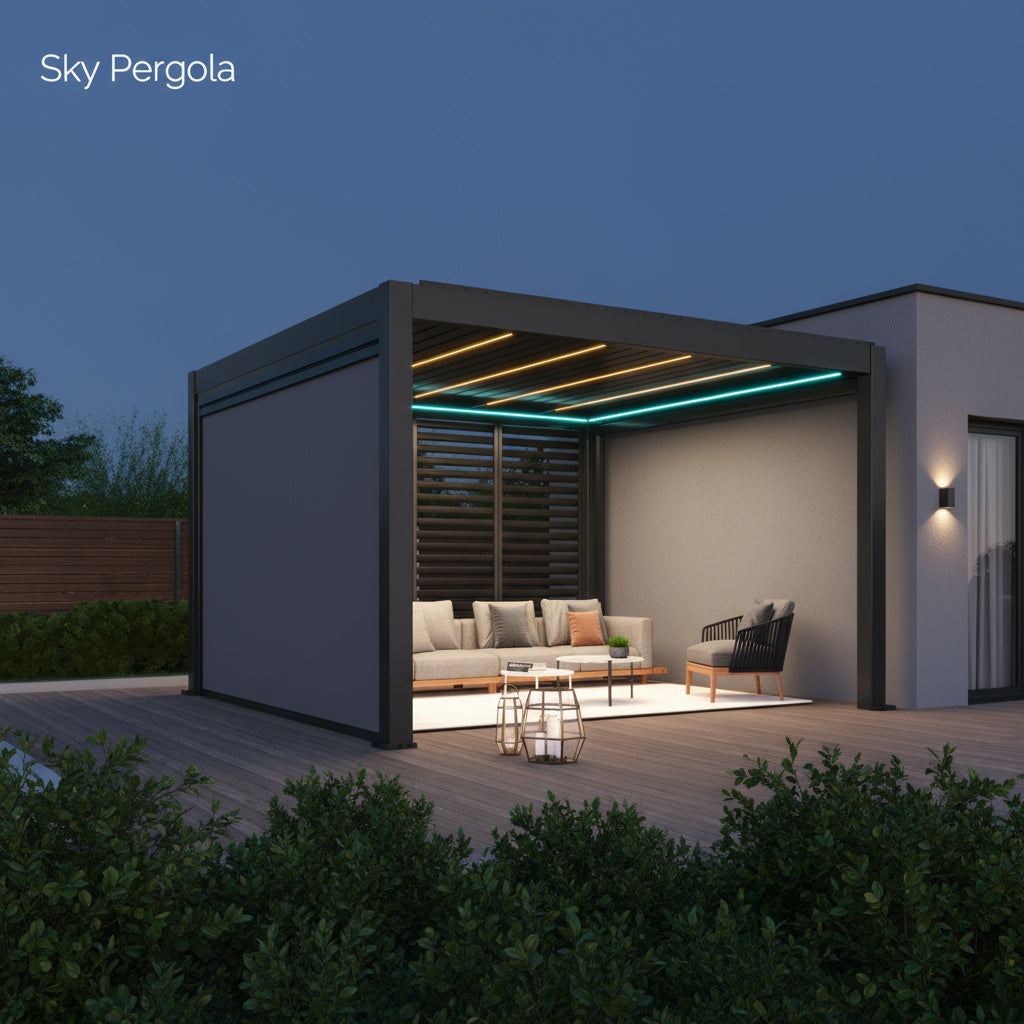
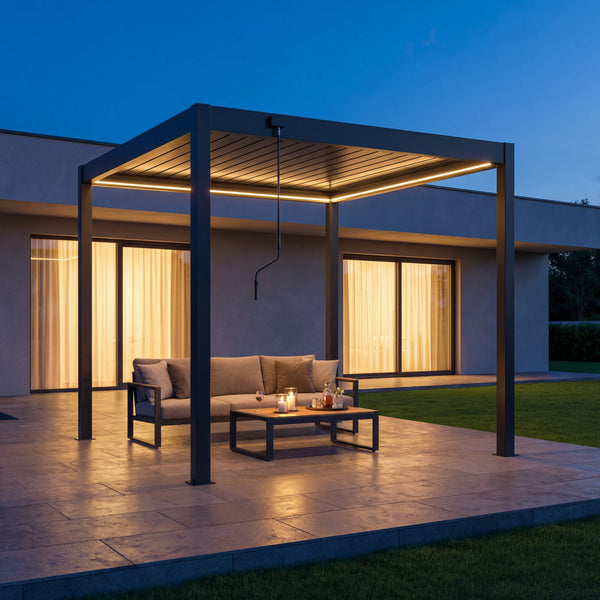

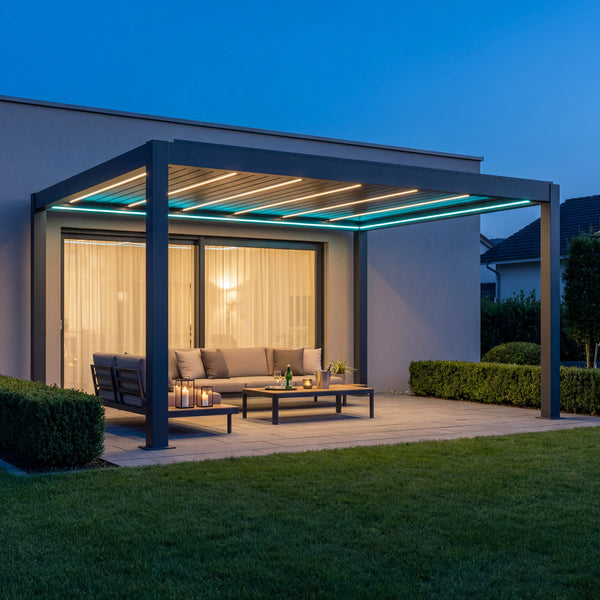








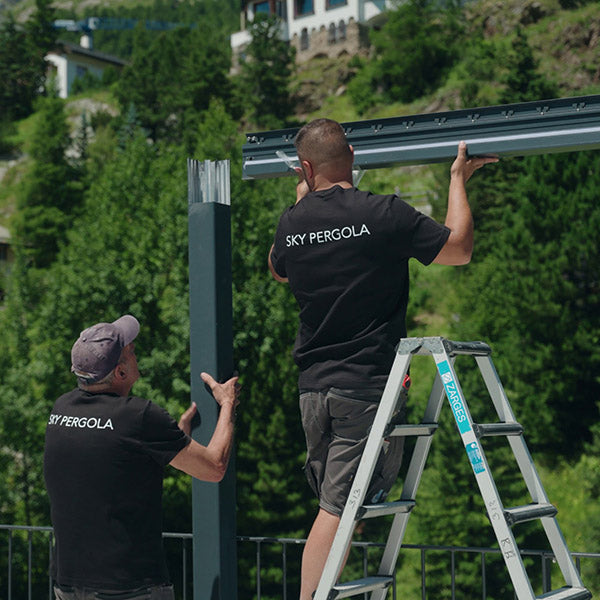

An aluminum pergola in Dubai is sold on the day you sign the order, but it is judged on the day it is finished. The crew is still on site, the ladders are still up, and the structure is clean, dry and dust-free for the only time in its life. That combination will not come back. Two weeks later, a scratch on a post foot is your problem, a gutter that holds water is a maintenance call, and a missing colour code is a guess.
This is the checklist for that one afternoon. It is written for a motorised louvre roof on a villa terrace, rooftop or poolside lounge in Dubai and the wider UAE, and it is deliberately practical: six inspection blocks you can work through in roughly 90 minutes with a garden hose, a torch, a tape measure and your phone. Suppliers and search results in the Emirates write the material both ways — aluminum pergola and aluminium pergola, sometimes pergola aluminum — and the checklist is identical either way. Nothing here needs a gauge, a laboratory or an engineer. Everything here is something an installer can either fix on the spot or has to write down.
The timing matters more in the Emirates than almost anywhere. Dubai gives you very few natural tests of a drainage system, and the ones it does give can arrive as a deluge rather than a shower. If your pergola is being handed over at the start of the outdoor season, you are a few weeks away from the only rain window of the year. Testing the water path with a hose now, while the people who built it are watching, is the difference between a snag and a dispute.
Key takeaways
- Budget 60 to 90 minutes and six blocks: coating, louvre picture, hose test, posts and fixings, function test, handover file. Do them in that order, because each one can reveal something the next one explains.
- Inspect the finish at the edges, not in the middle: cut ends, mitred corners, post feet, bracket points. The QUALICOAT architectural specification works with a nominal 60 µm and requires a minimum of 80 % of that specified value across multiple measuring points [1].
- Run the hose before the first rain. Dubai averages only 79.2 mm of rain a year on about 21.4 days with 1 mm or more [2], and roughly 85 % of it falls between December and March [3]. And a single event can deliver about two years' worth of rain in a day, as in April 2024 [4].
- Your handover file is worth more than the inspection: a dated invoice stating trade name, address, type of goods, price and quantity is a documented consumer right in the UAE [5], and the warranty period starts when you receive the goods [6].
- Get the colour code of the finish in writing. It is the single line that decides whether a repair in year seven looks invisible or looks like a repair.
- Handover also starts the long clock: decennial liability makes contractors and designers responsible for certain structural defects or collapses for ten years after project completion [7]. Dates and photographs are what make that usable.
Aluminum pergola in Dubai: why handover day is the only moment you hold all the leverage
Three things line up on handover day and never line up again. The installers are present with the tools, access equipment and spare components that would otherwise require a scheduled return visit. The structure is in its reference state, so any mark, gap or stain is demonstrably theirs rather than yours. And the commercial relationship is still open, which is the only reason a snag list has teeth.
There is a legal layer too. In Dubai, taking a completed structure into use is tied to inspection: occupation is prohibited until an inspector has verified that the works meet the terms of the permit and the completion certificate has been issued [8]. That principle is worth borrowing even for a small addition on a villa plot. Sign-off is not a courtesy to the crew; it is the point at which you accept what has been built.
What you can realistically check in 60 to 90 minutes
You are not auditing the engineering. You are checking the things that are visible, testable and cheap to correct today. Here is how the time divides.
| Block | What you check | Time | What you need |
|---|---|---|---|
| 1. Powder coating | Cut ends, corners, post feet, bracket and fixing points, touch-up quality | 15 min | Daylight, torch, phone camera |
| 2. Louvre picture | Gap consistency, closing line against the sun, rattle, synchronisation | 15 min | Remote plus a second person |
| 3. Hose test | Gutters, post drainage, ground outlet, wall connection | 20 min | Garden hose and tap access |
| 4. Posts and fixings | Plumb, square, caps, sealant joints, cable entries | 10 min | Level app, tape measure |
| 5. Function test | Full cycle, end positions, obstruction behaviour, accessories | 15 min | All handsets and switches |
| 6. Handover file | Warranty, colour code, care sheet, spare parts, contact, photos | 15 min | Printed snag list |
Those six blocks add up to 90 minutes. If the documents were emailed in advance and you only verify them on site, block six shrinks and the whole walk-through lands closer to 60. Do not compress the hose test to save time; it is the one block that cannot be repeated later without the installer present.
What to have in hand before the crew packs up
- The order confirmation and drawings, including the configured options, so you are comparing the structure against what you bought rather than against what you remember.
- A garden hose with working tap access on the terrace. Arrange this the day before, not during the visit.
- A torch, a tape measure and a spirit level or a level app on your phone.
- A printed snag list with space for location, observation, required state, photo reference and deadline.
- A phone with battery and storage for roughly forty photographs, and a second person who can operate the remote while you watch the roof.
Step 1: Powder coating — inspect the edges, not the middle
Nobody damages the middle of a beam. Damage happens where profiles are cut, handled, clamped, drilled and stood on end. Coastal plots in the Emirates make this more than cosmetic: in the ISO corrosivity classification, category C5 covers coastal areas with high salinity and category CX covers offshore areas with high salinity along with sub-tropical and tropical atmospheres [9]. A bare cut end on a coastal plot is not the same defect as one well inland — ask your supplier which ISO corrosivity category [9] applies to your location.
Where the damage actually shows up
- Cut ends of beams, posts and louvre blades, especially where a profile was shortened on site rather than in the factory.
- Mitred corners, where two coated faces meet and the coating is naturally thinnest.
- Post feet and base plates, from standing the structure upright on tiles or decking during assembly.
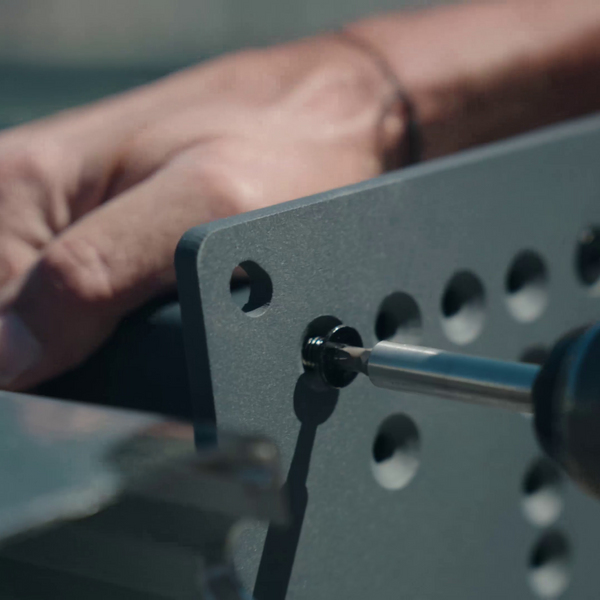
- Bracket and fixing points, where a spanner has slipped or a washer has been over-tightened.
- Transport edges that were taped or film-wrapped, where adhesive residue can be mistaken for a mark.
- Drill swarf left under washers, in gutters or on horizontal surfaces. Steel swarf rusts and stains a coated surface permanently.
How to tell a clean touch-up from a bodge
Touch-ups are normal and not worth a fight. Bad touch-ups are worth a snag entry. Judge them in daylight, never under the pergola lighting, and look at each repair from two angles rather than straight on.
- Colour reads the same as the surrounding surface when you move your head, not just from one position.
- Gloss level matches. A matt blob on a satin frame is visible from across the terrace and will stay visible.
- No brush ridges, no runs, no thick bead sitting proud of the surface. The edge should feather, not step.
- No overspray on adjacent surfaces, glass, screens or floor tiles.
- No paint bridging a louvre gap, a drainage slot or a moving joint. Paint that seals a drainage path is a drainage defect dressed as a repair.
- Surfaces washed down, with swarf and dust removed, before you are asked to inspect.
The measurable benchmark worth asking for
You cannot measure film thickness on handover day, but you can ask what was specified and request the coater documentation. The QUALICOAT architectural specification works with a nominal value of 60 µm and requires a minimum of 80 % of the specified 60 µm across multiple points [1] — ask the coater whether that is reported as a single reading of 48 µm or as the share of measuring points that reach the specified value, because the wording is read both ways and you want to know which one you are being given. For locations near the water there is a stricter class: QUALICOAT Seaside doubles the pre-treatment etch to a minimum removal of 2 g/m² of the aluminium surface, is intended for projects close to the coast or tidal water, and requires coaters to hold an additional licence [10]. The specific distance rule published alongside it is British and Irish guidance, so do not treat it as a Dubai threshold — instead ask your supplier directly whether your plot, your exposure and the ISO C5 or CX picture [9] justify the coastal class, and have the answer put in writing. A cross-hatch adhesion check belongs with the coater on an offcut, not on your finished frame.
If you want the material background before the installation date rather than on it, the aluminium pergola hub page for the UAE sets out why powder-coated aluminium is the default choice here, and the Sky Pergola installation guide for Dubai covers what happens before the crew ever arrives.
Step 2: The louvre picture — gaps, closing line and synchronisation
The louvre picture is one of the most honest indicators of installation quality, and it is the one thing no sales page describes. It takes five minutes to read and it tells you whether the frame is square, whether the blades are straight and whether the linkage was adjusted or simply bolted on.
Even gaps across the full span
Stand at one end of the roof, bring your eye roughly to the level of the blades and sight along them. Then do the same from the opposite end, and again from each of the two long sides. With the louvres part-open, the gaps should read as a set of parallel lines of equal width over the whole span. A gap that widens towards one end is a wedge, and a wedge means either the frame is out of square or one blade is not sitting in its bearing properly. A single blade that sits lower than its neighbours is usually the easiest fix of the day and the hardest to get fixed next month.
The sun test
Close the roof completely and stand underneath with the sun on the other side. You are looking at the closing line where the blades overlap. A continuous bright line running the length of one blade is a finding: the blade is not reaching its closed angle, or its overlap is not engaging. Point at anything you see and ask the installer to explain it, then write the explanation into the snag list even if it sounds reasonable. If water appears in the same place in January, nobody can then claim the subject never came up.
Be honest with yourself about what a closed louvre roof is. A good bioclimatic roof is rainproof and channels water away through an integrated rain drainage system, which is what makes it usable during the short UAE winter showers. It is not a sealed building envelope, and in an extreme storm water can enter in places by the nature of the construction. Expect a roof that sheds rain and drains it, not one that behaves like a concrete slab.
Rattle, run-out and thermal reality
Cycle the roof to roughly a quarter open, then half, then three-quarters, and listen at each stop. A loose blade knocks against its neighbours or its bearing, and in the Gulf this is usually a clearance problem rather than a broken part. A roof handed over in winter still has to cope with the summer: the mean daily maximum in Dubai is 41.9 °C in August against 24.4 °C in January, about 17.5 °C apart [11], before any surface heating on dark powder coating is counted. Clearances therefore have to be deliberate. Ask whether what you hear is designed movement or a blade that needs adjusting, and get the answer in the file.
On a multi-bank roof, watch that all banks reach the closed position together, not one after the other. On the Sky Pergola systems the drive sits out of sight inside the beam, so what you can assess is the behaviour of the blades themselves: smooth, simultaneous, no hesitation at the same point on every cycle. The explanation of how a motorised louvre roof works is useful background if you want to understand what you are watching.
Step 3: The hose test — find the water path before the Dubai winter does
This is the block most often skipped, and the one buyers regret skipping. The point of the hose test is not to prove the roof keeps water out. It is to find out where the water actually goes, with the people who built the path standing next to you.
Why it has to happen now
Dubai gives you very few opportunities to learn this the natural way. The official climate normals for 1991 to 2020 at Dubai International Airport give a mean annual precipitation of 79.2 mm spread over only 21.4 days with 1 mm or more [2]. Of that annual total, December to March account for 67.2 mm, about 85 %, split as 14.8 mm in December, 20.8 mm in January, 9.9 mm in February and 21.7 mm in March, while June to October together bring under 3 mm [3]. And the rain does not always arrive politely: in the April 2024 event, Khatm al-Shakla in Al Ain recorded 254.8 mm in 24 hours and Dubai International Airport about 144 mm in a single day, which the study describes as roughly two years' worth of rainfall [4]. Your first real test may well be the worst one.
The procedure, in order
- Close the roof fully. Run the hose onto the centre of the roof for about two minutes as a flood, not a jet. You want volume, not pressure.
- Move to each gutter in turn and flood it for about a minute. Watch the far end for overflow, then stop the water and look again after thirty seconds: standing water left in a gutter after the flow stops is a fall problem, and in a dusty climate a gutter that holds water also holds silt.
- Watch each post while the water runs. Ask which posts are drainage posts, then confirm that water disappears into those posts and emerges where it is supposed to. On the Sky Pergola models the posts carry the rainwater away; you want to see that happen, not be told it happens.
- Follow the water at ground level. Where does it leave the post, does it run away from the terrace, does it pond on tiles or decking, and does it discharge against a wall, into a planter or across the route people walk at night.
- For a wall-mounted structure, flood the wall connection from above and then inspect the junction from underneath with a torch. Look for beading, for a capillary gap behind the flashing and for a sealant bead that stops short of the end.
- Finally, open the louvres while everything is still wet and watch where the retained water goes. A sheet of water dumped into the seating area on opening is a snag, not a feature.
Where the outlet is allowed to go
Ask the installer where the discharge is routed and have it checked on site before anyone connects a downpipe into the nearest available drain. Dubai keeps rainwater and wastewater strictly separate: the Rainwater Drainage Network is defined as the installations draining rainwater, groundwater and surface water, and discharging wastewater into it is prohibited [12]. That is a plot-level question for your villa, and it is far easier to resolve on handover day than after a connection has been buried.
Photograph the clean state
Before you finish this block, photograph the inside of every gutter, the louvre bearings and the post outlets while they are clean. Airborne dust in the UAE is seasonal and peaks in the hot half-year, with dust events taking place mainly between March and August when enhanced shamal conditions raise the probability of dust suspension and dust storms [13]. A dated photograph of clean gutters at handover removes contamination as an argument later.
Step 4: Posts and fixings — plumb, tight, sealed, finished
Plumb and square without special tools
Put a level app or a spirit level on two faces of each post, ninety degrees apart. A post that reads plumb on one face and leans on the other is still a leaning post. Then measure both diagonals of the footprint with a tape: on a rectangular structure the two diagonals are equal, so any noticeable difference between the two diagonals means the frame is out of square — ask the installer what tolerance the system is built to and have the figure written down. An out-of-square frame is usually also the explanation for any wedge-shaped louvre gap you found in block two.
Do not assume the roof should be dead level. Louvre roofs are normally set with an intended fall towards the gutters. Ask what the designed fall is, confirm that what you measure matches it and write the figure into the file so that nobody later diagnoses the designed fall as a defect or vice versa.
Caps, bolts and sealant joints
- Press every cover cap with a thumb. Loose caps come off in the first strong wind and are rarely stocked.
- Look for visible fasteners where the design hides them, for washers that are not seated flat, for stripped heads and for two different fastener types on the same bracket.
- Sealant beads should be continuous, tooled rather than smeared, adhered on both sides and finished at the ends. A bead that stops 20 mm short of a corner is an open joint.
- No sealant blocking a drainage slot or weep opening. This is a common well-intentioned mistake on site.
Cable entries and the stainless-against-aluminium question
Cable entries should face downwards or use a proper gland. A cable pushed through a drilled hole and sealed with a blob is a future water path and a future chafe point. Slack cable coiled inside a gutter is a blockage waiting for dust season.
On fasteners, keep the question factual rather than alarmist. Bimetallic corrosion only runs where dissimilar metals are bridged by moisture, and it is driven by area ratio: stainless steel fasteners in aluminium sheet are normally considered safe, while in marine conditions uninsulated stainless bolts caused severe localised pitting of the aluminium that insulating washers prevented [14]. So on a coastal plot, ask which fasteners were used, whether any isolation is applied where the structure anchors into other metal, and have that answer recorded. It costs nothing on the day.
Step 5: Function test — drive, end limits, remote and accessories
Full cycle and end positions
Run the roof from fully closed to fully open and back, twice, and time it. The two cycles should sound and behave identically. Hesitation at the same point on both cycles is a mechanical finding, not a quirk. At each end position the blades should stop and the drive should go quiet; a motor that continues to strain or buzz after the blades have stopped is an end-limit setting that needs adjusting before you sign.
Ask the installer to demonstrate how the end positions are set, who is allowed to reset them and what the procedure costs after the warranty period. Ask separately what the drive does if something blocks the blades, and have the installer demonstrate it with a suitable object. Never test obstruction behaviour with your hand.
Remotes, pairing and power cuts
Hand over every handset in the room, not one. Confirm how many were supplied, how a replacement is ordered, which batteries it takes, and how a new handset is paired if one is lost. Ask what happens after a power cut: whether settings are retained, whether the roof returns to a defined position and whether the blades can be brought to a safe position without power. Write the answer down; it is the question people ask for the first time in the middle of an outage.
Not every model has a drive to test. The SkyLite ECO aluminium pergola has a manual louvred roof, so this block becomes a test of the manual mechanism: smooth travel across the full range, no binding at the extremes, and a clear explanation of how to leave it set during a storm.
Accessories, one at a time and then together
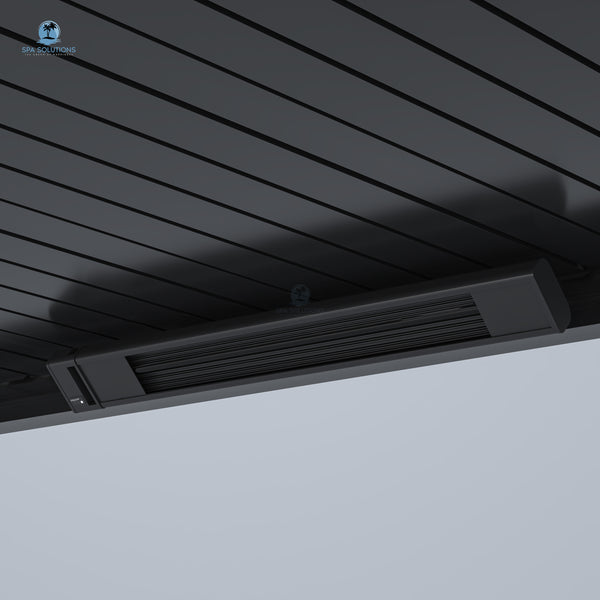
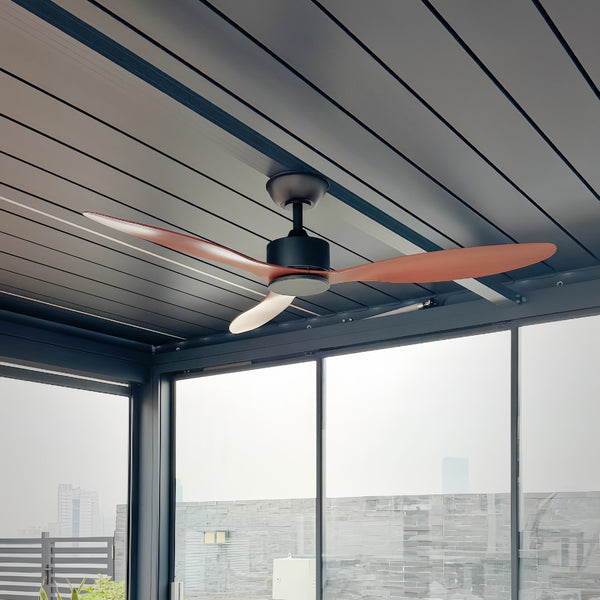
Test each accessory on its own control first, then run everything at once. Integrated LED lighting sits inside the frame and shines downwards, so check the beam for even output across the whole run rather than a bright section and a dim one. If a Sky Pergola side blind is part of the order, run it fully down and fully up and check that it tracks straight and sits square at both ends; if it is motorised, ask how the end positions are set. The fan comes with a remote control offering multiple speeds, so test every speed. The patio heaters come in two variants, so confirm which one was installed and have it stated on the invoice.
IP ratings in a dust climate
Ask for the ingress protection rating of the motor, the driver, the lights, the fan and any speaker, in writing. The rating is defined by IEC 60529, the IP Code standard, which covers protection against solid objects and contact as well as protection against ingress of water [15]. In an environment where dust events run mainly from March to August [13], the dust side of that rating is not a technicality, so ask which figure applies to each component. Do not accept a verbal reassurance; accept a number on paper. The electrical connection itself should be checked on site by a qualified electrician, and if you are unsure what was installed, ask us before you sign.
Step 6: The handover file and the paperwork that outlives the installers
The inspection protects the next month. The file protects the next fifteen years. This is the block people skip because the pergola already looks finished, and it is the block that costs the most to reconstruct later.
| Document | Why it matters | If it is missing |
|---|---|---|
| Dated invoice with supplier trade name, address, type of goods, price and quantity | A documented consumer right in the UAE [5] | Do not sign off until it is issued |
| Warranty documents for frame, finish, drive and electrics, with the handover date on them | The warranty period starts when you receive the goods [6] | Log the handover date in the snag list and have it countersigned |
| Colour code and coating system of the finish, in writing | Decides whether a future repair is invisible or obvious | Request it from the coater via the supplier before sign-off |
| Care instructions specific to your model | Separates owner duties from warranty duties | Ask which cleaning agents void anything |
| Spare parts and maintenance mechanism, and a named service contact | Suppliers must keep a written mechanism in Arabic for spare parts and maintenance that is easily accessible to consumers [6] | Ask where it is published and note the reference |
| As-built photographs of the finished installation | Your reference state for everything that follows | Take them yourself before the crew leaves |
The colour code is the line that matters most
Ask for the colour reference, the gloss level, the coating system and the name of the coater, and ask for them on the invoice rather than in a message thread. On the Sky Pergola models the posts, beams and louvres share the same colour, so a single code covers the whole visible structure. Without that code, a touch-up in year seven is colour matching by eye on a surface that has spent seven summers under Gulf sun.
Warranty, and what is actually covered
Read what each warranty covers before you file it. Sky Pergola states a 10-year warranty on the aluminium structure; the finish, the drive and the electrical components are separate questions and should be listed separately in your file. Because the warranty clock starts on receipt [6], the handover date needs to appear on paper that both sides have signed, which is exactly what a completed snag list does.
Permits, certificates and the ten-year clock
Do not let anyone tell you a pergola is automatically outside the permit system, and do not assume the opposite either. In Dubai, no construction work that permanently or temporarily changes the features of land or property may be carried out without a permit from the competent department, and the legal definition of construction works expressly includes additions and modifications to buildings [16]. Occupation of a completed building is prohibited until an inspector has verified that the works meet the terms of the permit and the completion certificate has been issued [8]. The completion certificate itself is defined as a document issued by Dubai Municipality certifying that a building is fit for occupancy and use as per the building permit and plans, with the current procedure set out in Administrative Resolution No. (275) of 2024 of 6 August 2024, which repealed the earlier 2019 resolution [17].
Whether your specific freestanding structure needs its own permit on your specific plot is a question for the competent department that issues permits for construction works in the Emirate [16]. Ask Dubai Municipality, which is the body that issues the completion certificate [17], and ask your master developer separately whether a community NOC is required before works start. Treat any supplier who answers either question with a blanket yes or no, and without naming the authority, as a warning sign.
On the engineering side, ask for the wind-load calculation referenced to the Dubai Building Code. The Code is binding on everyone designing construction works anywhere in the Emirate, including Special Development Zones and free zones, for permits issued after Decree No. 45 of 2021 took effect [18], and Dubai Municipality states its objective is to unify building design across Dubai and clearly mandate minimum requirements for the health, safety, welfare and convenience of people in and around buildings [19]. Older figures circulate widely: a 2018 news report described a requirement that structures withstand a basic wind speed of 45 metres per second for a three-second gust, equivalent to 160 km/h [20]. Treat that as historical background and insist on a current calculation from your supplier rather than a number from an article.
Two long clocks start around handover. Decennial liability makes contractors and designers responsible for certain structural defects or collapses for ten years after project completion, and it survived the overhaul of UAE civil law, with the new Civil Transactions Law taking effect on 1 June 2026 [7]. Separately, Dubai has tightened the long-term regime: Law No. (3) of 2026 on the Quality and Safety of Buildings, issued 27 February 2026, applies to all buildings in the Emirate regardless of construction date and requires a Quality and Safety Certificate once twenty years have passed since the completion certificate was issued [21]. Neither clock helps you if you cannot prove when the work was completed and what it looked like. Dates and photographs are the whole point.
The printable snag list: wording that holds up
A snag list fails when it is a list of adjectives. It works when each line is specific enough that a third person who was not present could walk onto the terrace and decide whether the item is closed. Five elements do that job.
- Location — name it the way the structure is numbered or the way the plot is oriented: post 2 (south-east), east gutter, wall connection at the sliding door.
- Observation — what you see, neutrally and without a diagnosis: coating missing on the cut end over approximately 30 mm.
- Required state — what closed looks like: cut end coated to match the adjacent surface in colour and gloss, with no brush ridges and no overspray on the tiles.
- Evidence — photo reference and date: photo 14, 2 November 2026.
- Deadline and status — a date, and whether this item is open, closed on site or deferred.
Useful wording patterns, in the structure above:
- Post 3 (north-west), base plate: coating chipped at two points, each roughly 10 mm. Required: touch-up matching colour and gloss, inspected in daylight. Photo 7. Due 9 November. Status: open.
- East gutter: approximately 1.5 cm of standing water remains 60 seconds after the hose test ends. Required: free drainage with no retained water after flow stops. Photos 18 and 19. Due 9 November. Status: open.
- Louvre bank 2, blade 4: gap widens towards the south end compared with neighbouring blades. Required: uniform gap across the span, assessed by sighting from both ends. Photo 11. Due 9 November. Status: open.
- Documentation: colour code, gloss level and coater name not supplied at handover. Required: supplied in writing and stated on the invoice. Due 9 November. Status: open.
- Function: obstruction behaviour of the drive demonstrated and explained on site. Status: closed on site, recorded for reference.
Partial release versus full sign-off
If the structure is usable but items remain open, do not choose between refusing to sign and signing it all away. Record a partial release: state that the installation is accepted for use, that the listed items remain open with the agreed deadline, and that acceptance for use is not acceptance of those items. Settle the open points in writing, with a date, before you confirm acceptance in full — a serious supplier will work that way in any case, and if your contract provides for a final instalment, that is the moment to discuss it. Add the handover date, both names and both signatures, and photograph the signed sheet before anyone leaves with it. If the amount at stake is significant to you, have the wording checked by your own adviser before the appointment rather than improvised on the terrace.
Matching the checklist to your Sky Pergola model
The six blocks apply to any aluminium louvre roof, but which blocks carry the most weight depends on what was installed. The Sky Pergola range is designed in Switzerland and specified per model, so use the model sheet rather than a general assumption.
- SkyInfinity Pro aluminium pergola — a fully retractable louvred roof that opens up to 70 %, available in 3x3, 3x4, 3x6, 4x4, 4x5 and 4x6 metres, with wind resistance up to 150 km/h, snow load up to 120 kg/m², integrated LED lighting in the frame and rainwater drainage through the supporting posts. Add one item to block five: run the roof to its fully retracted position and back, twice, and watch that it reaches the same end point both times.
- SkyMax Ultra aluminium pergola — 4x6 metres with illuminated louvres and motorised operation, wind resistance up to 120 km/h, snow load up to 80 kg per square metre, and posts that drain rainwater away to prevent puddles. On a span this size, block two matters most: sight the gaps from all four sides.
- SkyMotion LED aluminium pergola — 3x3 metres with integrated LED and a motorised louvred roof, drainage through posts, louvres and gutters, wind up to 120 km/h and snow load up to 60 kg per m². A compact footprint does not shorten blocks two and three; it only makes them quicker to work through.
- SkyLite ECO aluminium pergola — 3x3 metres with integrated LED and a manual louvred roof, wind up to 120 km/h and snow load up to 50 kg per m². There are no end limits to test, so spend the time on the manual mechanism and the drainage instead.
- SkyGrand Master aluminium pergola — 5m x 5m with no central posts, snow load capacity up to 270 kg/m², wind speeds up to 120 km/h and integrated LED louvres. A clear span this size makes the diagonal measurement in block four more informative, not less.
- SkyPergola Carport — available as Single, Double or Triple Car in sizes S, M or L, either freestanding or enclosed with three sliding louvre walls plus a reinforced front roller blind designed for wind loads up to 100 km/h. If the roller blind is part of your order, run it fully down and fully up in block five and check that it sits square at both ends.
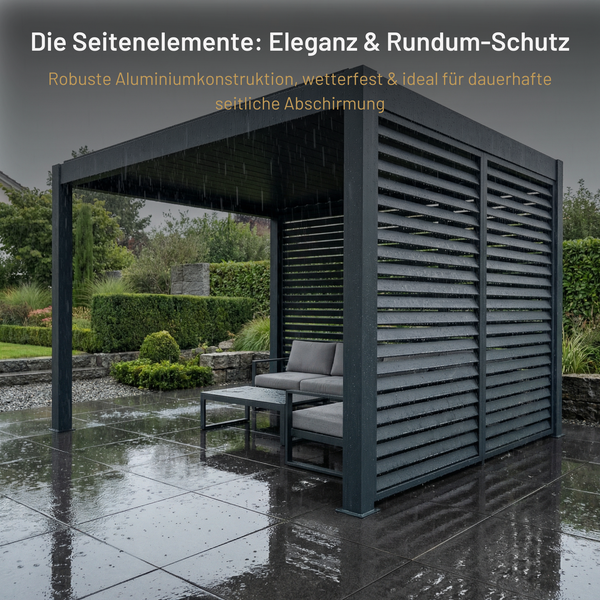
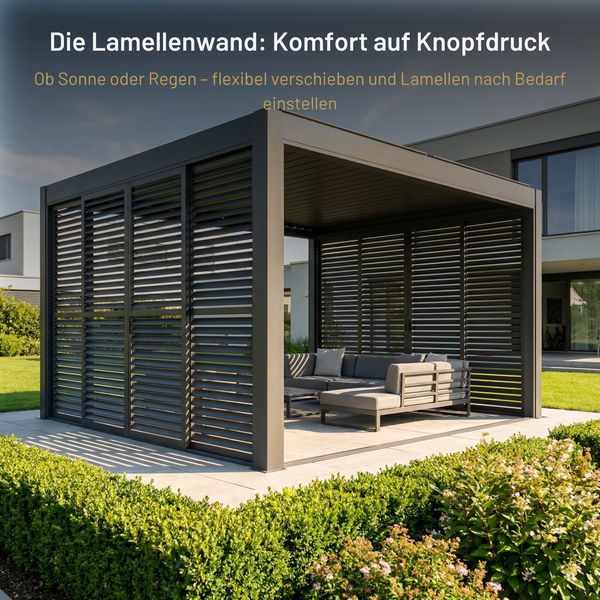
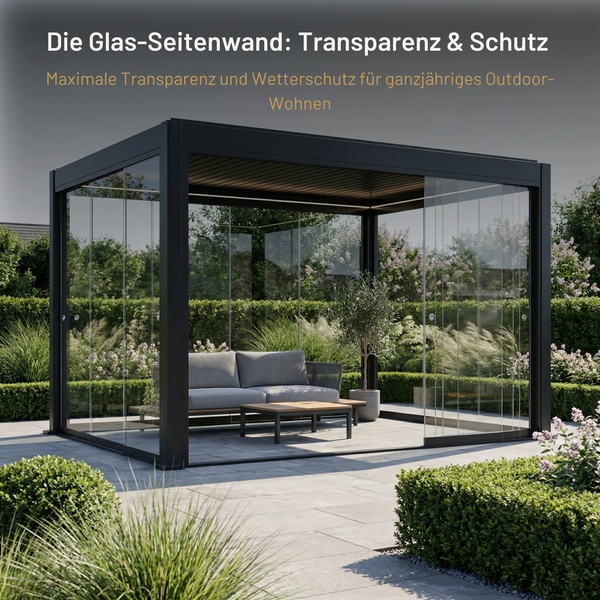
Side walls change what block three has to cover. Glass side walls are made from 10 mm safety glass and slide, the sliding louver wall moves as a wall while its louvre panels open or close individually, and the fixed side element is an aluminium louvre wall that provides reliable protection from rain. Wherever a wall meets the frame or the floor, flood that junction with the hose as well instead of assuming the roof test covered it.
Verdict: ninety minutes that decide the next ten years
Everything in this checklist is reversible on handover day and expensive afterwards. A scratched post foot is a five-minute touch-up while the crew is there and a scheduled visit once they have gone. A gutter that holds water is an adjustment today and a stained terrace in January. A missing colour code is one line on an invoice now and an unsolvable colour match in year seven. The structure itself is likely to be fine — powder-coated aluminium is the default choice here for exactly these conditions. What varies between suppliers of aluminum pergolas in the UAE is the last five per cent, and the last five per cent is exactly what a 90-minute walk-through exposes.
So do the six blocks in order, bring the hose, photograph the clean state, insist on the file, and write the snag list in locations and required states rather than adjectives. Accept the installation for use if it is usable, and keep the open items open in writing. That is not an adversarial approach; a good installer will welcome it, because a signed and dated record protects them from your memory just as much as it protects you from theirs.
If you are still at the specification stage rather than the handover stage, decide the model, size, colour and side elements first and let the inspection follow from the spec sheet. You can put the whole configuration together, including side walls, lighting and accessories, in the Sky Pergola configurator, then print this checklist and keep it with the order confirmation until the day the crew packs up.
Frequently asked questions
How do I know if my aluminum pergola was installed correctly?
Work through six checks in about 90 minutes: the coating at cut ends and post feet, the louvre gaps sighted along the span, a garden hose test of gutters and post drainage, posts for plumb and square with equal diagonals, a full function test of drive and accessories, and the handover file. Anything you cannot judge, ask the installer to explain and record the explanation in writing before you sign off.
Is a closed louvre roof really waterproof?
A closed louvre roof is rainproof and sheds water through an integrated rain drainage system, which is what makes it usable during UAE winter showers. It is not a sealed building envelope, and in an extreme storm water can enter in places by the nature of the construction. Rain here can be violent: in April 2024 Dubai International Airport recorded about 144 mm in a single day, which the study describes as roughly two years' worth of rainfall [4].
How do I test the drainage of a new pergola before the first rain?
Close the roof, flood the centre with a garden hose for about two minutes, then flood each gutter for a minute. Watch for standing water after the flow stops, follow the water into the drainage posts, and see where it leaves at ground level. Ask where the outlet is routed, because Dubai keeps rainwater and wastewater strictly separate and discharging wastewater into the rainwater drainage network is prohibited under Local Order No. 8 of 2002 [12].
What powder coating thickness should I ask for in the UAE, and does a coastal location change it?
The QUALICOAT architectural specification works with a nominal 60 µm and requires a minimum of 80 % of the specified 60 µm across multiple points [1]. Ask the coater whether that is reported as a single reading or as the share of measuring points, because the wording is read both ways. Near the water, ask about the Seaside class, which doubles the pre-treatment etch to a minimum removal of 2 g/m² of the aluminium surface [10]. Coastal areas with high salinity sit in category C5 of the ISO corrosivity classification, and offshore areas along with sub-tropical and tropical atmospheres in CX [9].
Which colour code should I get from the installer for later touch-ups?
Ask for the colour reference, the gloss level, the coating system and the name of the coater, stated on the invoice rather than in a message. On Sky Pergola models the posts, beams and louvres share the same colour, so one code covers the whole visible structure. Without it, a repair in year seven is colour matching by eye against a surface that has already spent several summers under Gulf sun.
Do I need a Dubai Municipality permit for a pergola, and do I also need a developer NOC?
Do not assume either way. Under Local Order No. 3 of 1999 no construction work that permanently or temporarily changes the features of land or property may be carried out without a permit from the competent department, and the definition expressly includes additions and modifications [16]. The same law prohibits occupation of a completed building until it is inspected and the completion certificate is issued [8]. Ask Dubai Municipality about your plot, as the body that issues the completion certificate [17], and ask your master developer separately whether a community NOC is required.
How long is the warranty on an aluminium pergola in the UAE, and when does the clock start?
Sky Pergola states a 10-year warranty on the aluminium structure; finish, drive and electrical components are separate questions, so list them separately in your file. The warranty period begins when the consumer receives the goods, suppliers must maintain adequate after-sales service and spare parts, and they must keep a written mechanism in Arabic for spare parts and maintenance [6]. That is why the handover date has to be on signed paper.
How often does it actually rain in Dubai, and when is the rain season?
The official WMO climate normals for 1991 to 2020 at Dubai International Airport give 79.2 mm of rain a year on about 21.4 days with 1 mm or more [2]. Almost all of it falls in the winter half-year: the same normals put December to March at 67.2 mm, roughly 85 % of the annual total, while June to October together bring under 3 mm [3]. That is why the hose test replaces waiting for rain.
Sources
- QUALICOAT Expands on its Specifications – QUALICOAT UK & Ireland
- WMO Climatological Normals 1991–2020 — Dubai International Airport (41194) – World Meteorological Organization / NOAA National Centers for Environmental Information
- WMO Climatological Normals 1991–2020 — Dubai International Airport (41194) – World Meteorological Organization / NOAA National Centers for Environmental Information
- An extreme rainfall event over the United Arab Emirates in April 2024: Role of dynamic and thermodynamic drivers – Scientific Reports (Nature Portfolio), 2026
- Consumer protection – The United Arab Emirates' Government portal (u.ae)
- UAE consumer protection regime revamped – Out-Law / Pinsent Masons (legal news service), 6 October 2023
- UAE's transactions law resets court tests for project risk, pricing and exit economics – Out-Law / Pinsent Masons (legal news service), 24 July 2026
- Local Order No. (3) of 1999 Regulating Construction Works in the Emirate of Dubai, Article 25 – Government of Dubai – Dubai Legislation (Legal Affairs Department)
- Standard corrosion protection systems for buildings — atmospheric corrosivity categories – Steel Construction Institute (SCI) / British Constructional Steelwork Association, steelconstruction.info
- QUALICOAT Seaside – QUALICOAT UK & Ireland
- WMO Climatological Normals 1991–2020 — Dubai International Airport (41194) – World Meteorological Organization / NOAA National Centers for Environmental Information
- Local Order No. (8) of 2002 Concerning Sewerage, Irrigation, and Water Drainage in the Emirate of Dubai – Government of Dubai – Dubai Legislation (Legal Affairs Department)
- Optical and geometrical aerosol particle properties over the United Arab Emirates – Atmospheric Chemistry and Physics (European Geosciences Union), 2020
- Bimetallic (galvanic) corrosion – British Stainless Steel Association (BSSA)
- IEC 60529:1989+AMD1+AMD2 — Degrees of protection provided by enclosures (IP Code) – International Electrotechnical Commission (IEC)
- Local Order No. (3) of 1999 Regulating Construction Works in the Emirate of Dubai – Government of Dubai – Dubai Legislation (Legal Affairs Department)
- Administrative Resolution No. (275) of 2024 Approving the Procedures for Replacing Engineering Firms and Contracting Companies, and for Issuing Completion Certificates – Government of Dubai – Dubai Legislation (Legal Affairs Department)
- Decree No. (45) of 2021 Concerning the Dubai Building Code – Government of Dubai – Dubai Legislation (Legal Affairs Department)
- Dubai Building Code – Dubai Municipality
- New wind codes for Dubai towers – Gulf News, 15 September 2018
- Law No. (3) of 2026 Concerning the Quality and Safety of Buildings in the Emirate of Dubai – Government of Dubai – Dubai Legislation (Legal Affairs Department)
Last updated: November 2026


